Thirteen open standards tell AI systems something about your content: what it is, who may fetch it, what may be done with it, what it costs, and what happened after. In a vendor pitch they can sound interchangeable, but they do eight different jobs, and they stack. Two of them move money: x402 and MPP.
Updated
Ask your vendors. Put this to your CDN, bot-management vendor or marketplace, verbatim: "Which of these standards do you read, which do you enforce at the door, and who is paying under any of them through you today?"
A machine that buys content has to find it, identify itself, learn the terms, pay and report what it did. Each standard below does one or two of those jobs. The companies that sell access are on Content marketplaces, which also explains how a Broker orders offers for agents.
| Standard | Its job, and what it answers | Status, and who stands behind it | Who uses it |
|---|---|---|---|
| robots.txt | Declare terms: allow or block, per crawler | IETF standard, RFC 9309 (2022). Its rules "are not a form of access authorization" [1] | On sites using TollBit, 30% of AI bot scrapes in Q4 2025 ignored it (TollBit's own data) [2] |
| AIPREF | Declare terms: a preference about AI training and AI use | IETF working-group draft -08 (September 2026), without group consensus yet; the robots.txt training token is an individual draft [4, 5] | Anthropic has recognized the training token since October 30, 2026; Microsoft from February 1, 2027; Google intends to in early 2027; OpenAI "will honor" it [6, 7, 8, 9] |
| TDMRep | Declare terms: reserve text-and-data-mining rights | W3C Community Group final report (2024), "not a W3C Standard" [11] | More than 50 adopters on the group's own list, among them Hachette Livre, Elsevier, Springer Nature, Wiley and Radio France [12] |
| RSL | Declare terms: state license terms and prices; it also specifies a license server (OLP) | RSL 1.0, a Recommendation of RSL's Technical Steering Committee, December 2025 [14, 15] | More than 3,000 supporters, says ILC; one AI company licensed through ILC, Yahoo Scout [16] |
| IAB Tech Lab CoMP | Declare terms: describe content, its price and where its license is, for a marketplace API | IAB Tech Lab, final V1, April 2026 [21] | FORA carries CoMP: its fields travel whole on each FORA offer [22] |
| llms.txt | Help discovery: a curated index for AI readers | A proposal by Jeremy Howard, v2 August 2026; no standards body [31] | "thousands of sites publish an llms.txt file", by its author's count [31] |
| Web Bot Auth | Identify the caller: a signature on each agent request | IETF working-group draft, October 2026 [32] | ChatGPT Work's cloud browser signs with it [33]. Cloudflare verifies, and FORA agents sign, under two different earlier drafts [23, 34] |
| MCP | Connect: how an agent calls a tool or a seller | The Agentic AI Foundation, under the Linux Foundation; revision of July 28, 2026 [35, 36] | Cashmere, AskNews and Newstex sell content through MCP servers; FORA's Identity Service is one [22, 37, 38, 39] |
| C2PA | Prove origin: who made this, and has it changed | C2PA 2.5 (October 2026), a Linux Foundation project; ISO 22144 at committee draft [41, 42, 43] | Steering-committee members include Adobe, BBC, Google, Meta, Microsoft and OpenAI [44] |
| FORA | Declare terms, transact and report: a signed offer per term, the buyer's signed acceptance, a signed link, and the buyer's usage report | The open protocol this site describes. Apache-2.0, release v1.2.1, with FORA Server, an open-source implementation [22, 24] | Any company can run its own marketplace on it. See About FORA |
| x402 | Settle, which moves money: payment over HTTP 402 | x402 Foundation, under the Linux Foundation; 40 members by July 2026, Visa, Mastercard and American Express among them [48] | In AWS WAF on CloudFront since June 2026; in Cloudflare's Monetization Gateway, a closed beta since September 30, 2026 [49, 50] |
| MPP | Settle, which moves money: payment over HTTP 402, per charge, session or subscription | Co-authored by Tempo and Stripe; its core scheme is an individual Internet-Draft [52, 53] | Cloudflare's Agents SDK names it as one of its two payment protocols; AWS called MPP support "coming soon" in June 2026 [49, 54] |
| SPUR Content Telemetry | Report: what an AI system did with content after the fetch | SPUR Coalition, 1.0, September 2026 [55] | AskNews says it weights its publisher pool by its events [56] |
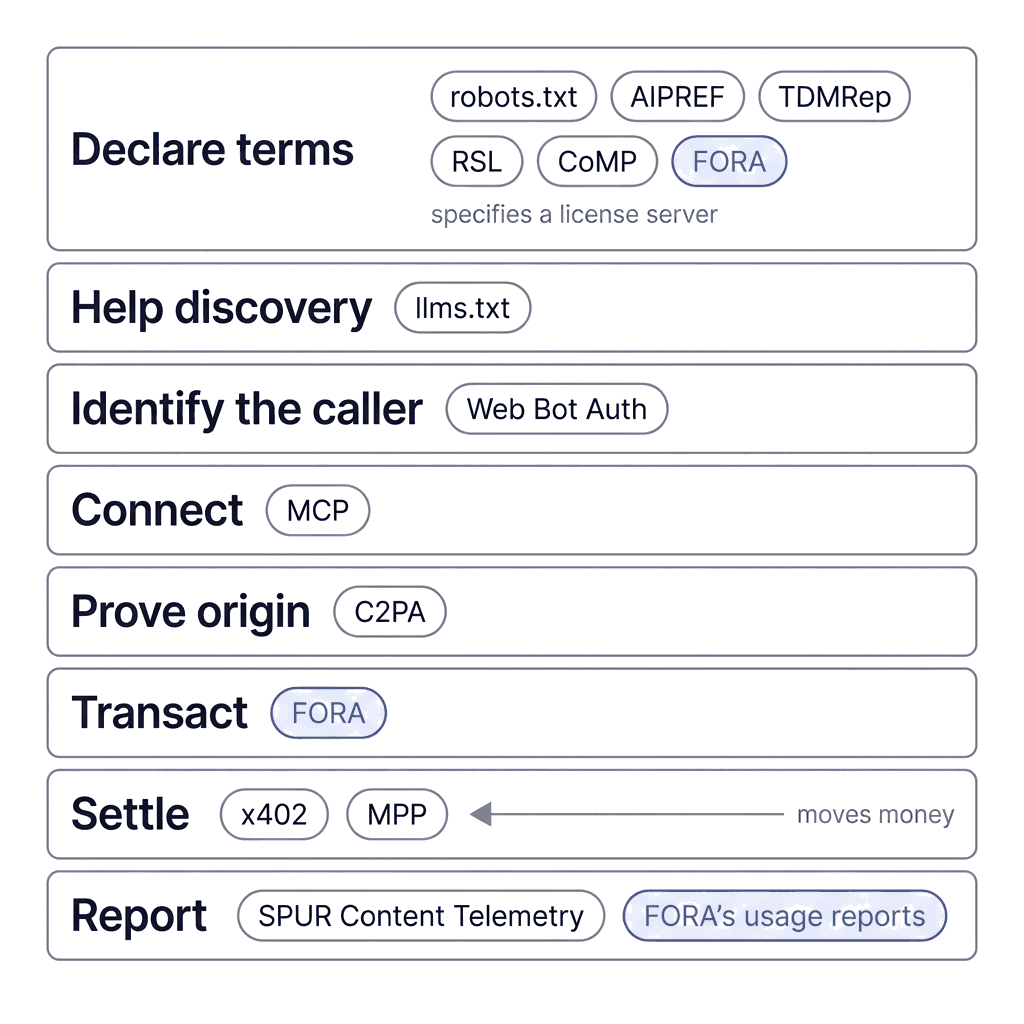
Eight layers, each a different job: declare terms (robots.txt, AIPREF, TDMRep, RSL, which specifies a license server, CoMP, FORA), help discovery (llms.txt), identify the caller (Web Bot Auth), connect (MCP), prove origin (C2PA), transact (FORA), settle, which moves money (x402, MPP), and report (SPUR Content Telemetry, FORA's usage reports).
How to read it. Each row does a different job, so the rows don't rank against each other: a road sign isn't worse than a till for not taking payment. The last column mixes kinds of adoption, and each cell says which.
Transacting agrees one sale; settling moves the money. RSL declares terms, and its specification describes a license server. FORA spans the terms, the transaction and the report, and leaves the money to your operator.
/rsl.txt, which the edge passes through to every client [27].The Movement for an Open Web publishes the Search Only Terms Contract, a legal text a publisher points to from robots.txt and incorporates into its site terms. Indexing for search and a person's own reading are free. A fee is owed for "scraping, bulk extraction, dataset creation, or any AI-related use", for each article, image, video or audio file, at the amount the publisher sets.
A contract covers what the edge function can't see: your open pages, and crawlers that hide what they are. How to adopt the contract →
FORA asks more of you than an RSL file, which a publisher can write in a minute [17]: an Exchange and keys, because it also transacts and takes the report. For a publisher choosing what to do this quarter, that difference may matter more than every comparison below the divider.
What FORA gives back is proof. You set several terms for a page: free for search, a price per AI answer, a yearly deal for one licensee. The Exchange signs an offer for each term the buyer may see. The buyer signs the one it picked, with its own registered key. The Exchange issues a signed link against that acceptance, and both sides keep the record [23, 28].
A buyer that says it didn't know the terms has its own signature on them. You can check it in the Exchange operator's publisher console, which verifies both signatures in your browser [27]. None of the other license formats, RSL's license server included, carries the buyer's own signature on the terms it accepted.
The rest of the page compares the specifications clause by clause. Everything above reads without it.
Three of the thirteen are license formats: RSL 1.0, CoMP and FORA's licensing core. All three say what you may do, who may buy, where, at what price, and what you owe afterward. TDMRep and AIPREF say only the first.
On uses they speak almost the same language. RSL defines six use words, from all to search [14]. CoMP takes the same six names, four definitions word for word [20]. FORA starts from RSL's use words and adds copyright uses such as reproduce and sync, 23 in all. It also accepts AIPREF's train-ai as a spelling of ai-train [28]. RSL and FORA both scope a term by place and kind of user, and both can prohibit as well as permit [14, 28].
On what you owe afterward they part. RSL's reporting rule: a client that "does not recognize or cannot comply with the profile MUST treat that activity as not licensed" [14]. CoMP has a citation flag and a reporting address [20]. FORA has obligations, credit and notices among them [28]. An unknown RSL element "MUST render the document non-conformant", so one element a client doesn't know affects the whole file [14]. A FORA agent that can't evaluate a term declines only that term [28].
RSL's <standard> element points at a legal text elsewhere, such as a Creative Commons license [14]. FORA incorporates by reference too, with the document's digest beside its address, so the document can't be swapped after an offer is signed [28].
attribution is one of the types [14]. CoMP keeps citation in a field of its own, beside the price [20]. A FORA term can charge per access and require credit [28].See it clause by clause. The Licensing Core explorer shows 12 licenses, each as a FORA term, an RSL file and a CoMP package.
Pick "AI answers, pay per crawl": RSL loses the credit, CoMP keeps it.
Pick "Annual AI access deal": the cap is in neither file.
Pick "Collective blanket license": neither RSL nor CoMP can pin the document's version.
RSL specifies a license server [14]. Supertab sells one, and Daily Kos's RSL file names it [57, 58]. No AI company is named as a buyer.
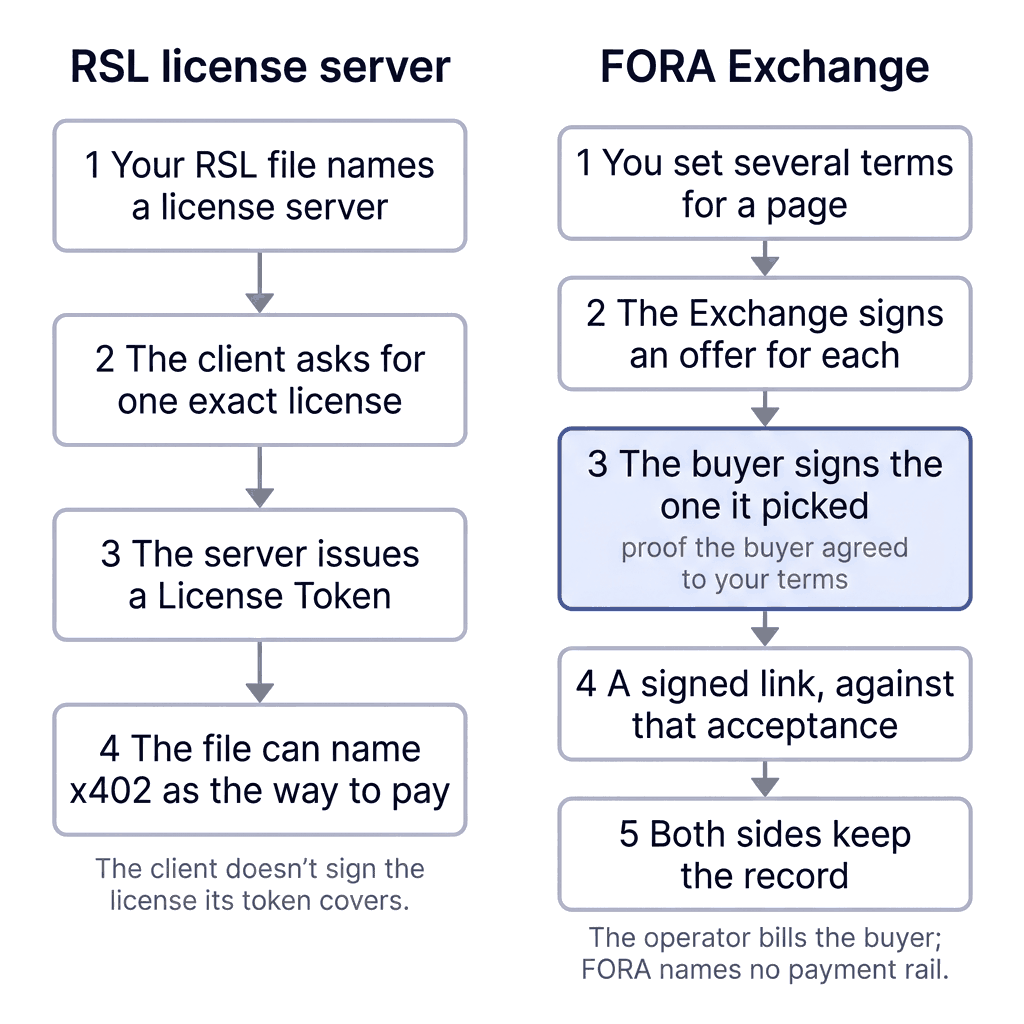
In RSL's words, the server "Implements the Open License Protocol (OLP) to issue license tokens and enforces payment requirements on behalf of Publishers". A license token is the pass it issues; a site or CDN can ask which license and asset it covers. The file can name x402 as the way to pay [14].
The difference that matters in a dispute is who signs. RSL's client doesn't sign the license its token covers, and <standard> takes an address with no digest (Appendix A) [14]. TollBit's content tokens name a license type and a license ID, and TollBit signs them, not the buyer [59]. CoMP records how a crawler plans to identify itself, which is not its assent [20].
What ILC does with it. ILC, the collective that co-authored RSL, keeps the transaction out of the content path [16, 18]. Its RSL file names no license server and points, through <standard>, at ILC's collective license [19]. An AI company takes one blanket license, for a fee ILC doesn't publish, and reports its own use [18]. Yahoo Scout, ILC's first licensee, pays under that contract [16]. How ILC compares with other collectives →

Two sequences side by side. RSL license server: your RSL file names a license server; the client asks for one exact license; the server issues a License Token; the file can name x402 as the way to pay; the client doesn't sign the license its token covers. FORA Exchange: you set several terms for a page; the Exchange signs an offer for each; the buyer signs the one it picked (proof the buyer agreed to your terms); a signed link is issued against that acceptance; both sides keep the record. The operator bills the buyer, and FORA names no payment rail.
C2PA defines signed provenance metadata bound to a file: who made it, with what tool, and what has been done to it since. Content Credentials is the consumer name [40]. Adobe, Arm, BBC, Intel, Microsoft and Truepic founded it in 2021 [45].
C2PA's core specification removed its training-and-mining assertion in version 2.0; the Creator Assertions Working Group's specification now carries that signal [41, 46]. A publisher who adopts C2PA has licensed nothing. It has evidence: a signed manifest with a content hash shows what was delivered and whether it changed. FORA carries C2PA validation results as a signed attestation about a resource [22]. Text has been in the specification since 2.3, but if text "is only partially copied", its manifest "may be truncated or absent" [41].
Two pairs that can contradict each other. RSL states which uses are permitted; CoMP leaves uses to the license it links, so the two can disagree unseen [14, 20]. If you publish both, check that they say the same thing. robots.txt governs fetching by crawler name and TDMRep reserves a use. The TDMRep group calls them complementary, but "this complementarity is not specified in the TDMRep document and remains subject to interpretation" [13].

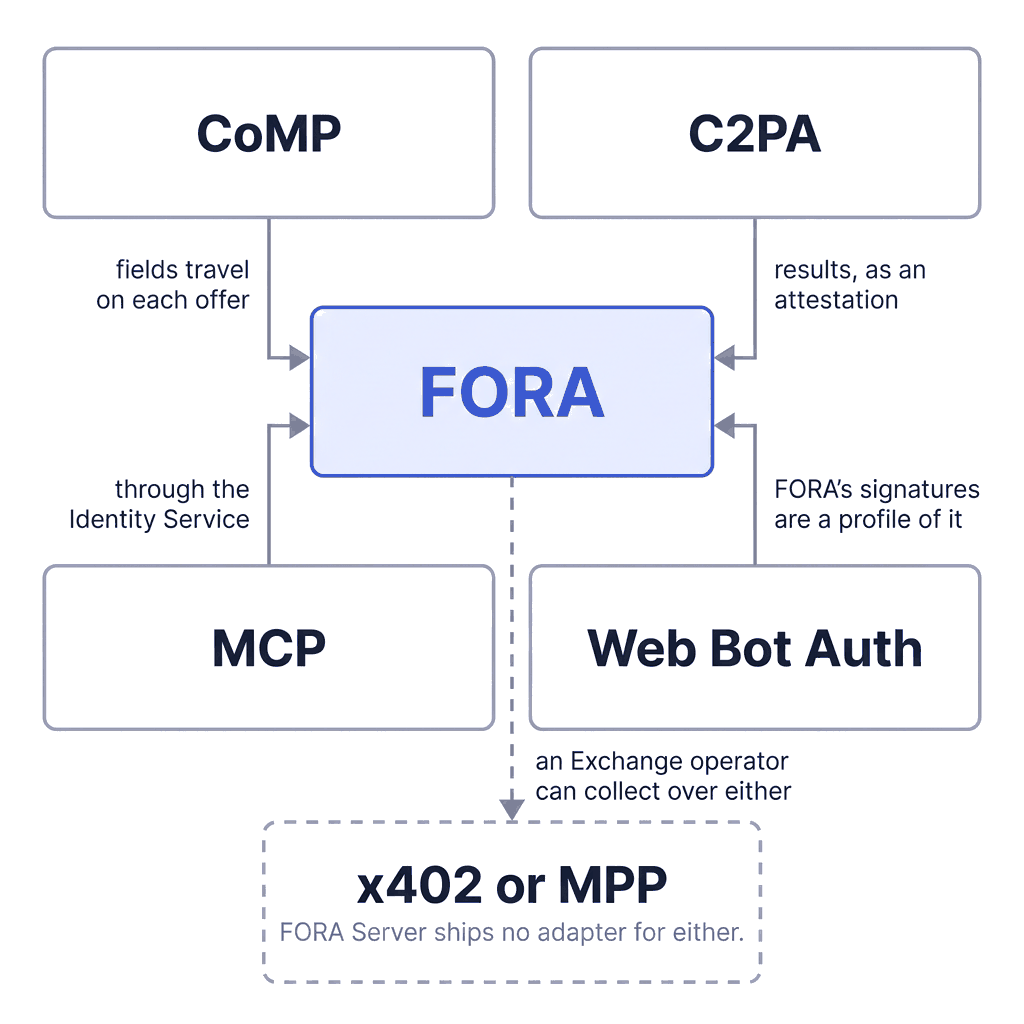
Four standards feed into FORA: CoMP's fields travel on each offer, C2PA's results arrive as an attestation, an MCP assistant reaches FORA through the Identity Service, and FORA's request signatures are a profile of Web Bot Auth. An Exchange operator can collect over x402 or MPP; FORA Server ships no adapter for either.
SPUR's Content Telemetry 1.0 specifies "a telemetry schema for tracking AI agent content usage from retrieval through user engagement". Your server or CDN can report retrieval "with no cooperation from the AI agent required"; only the AI company can report grounding, citation and presentation [55]. RSL's reporting element can point at a profile like this one [14].
In FORA, the buyer reports its usage to the Exchange that sold the item, and each report names the transaction it covers [22]. For disputes and payouts, see About FORA.
No. FORA doesn't replace RSL or CoMP. RSL publishes your terms in a file anyone can read. FORA sells under the terms you set in the publisher console, one signed offer at a time.
TDMRep is a machine-readable form of the reservation the EU's copyright directive recognizes. In the TDMRep report's summary of Article 4, mining is allowed unless "expressly reserved by their rightsholders in an appropriate manner, such as machine-readable means" [11]. Whether yours meets the test is a question for your lawyer.
IPTC's photo metadata has a data-mining property inside the image file [60]. ODRL is the policy language TDMRep uses [11, 61]. The European Commission's consultation lists Liccium's TDM·AI among opt-out protocols. The Commission hasn't published its list of generally agreed ones [62].
Sources are checked on the date of publication.
Generate your robots.txt and headers, attach the search-only contract, and see what an agent would be offered for one of your pages through a FORA marketplace, which any company can run.