Resources · Content marketplaces · Microsoft PCM

Microsoft's marketplace comes with Microsoft as the buyer. On FORA, any agent can buy, at a price you set before the sale.

Microsoft's Publisher Content Marketplace (PCM) licenses your content to AI products, mainly for grounding, where the AI uses your article to answer one question, and shows it as a cited link. Copilot is its first buyer. On FORA, an open protocol, any AI agent can buy each page on terms and at a price you set.

Updated

At a glance

PCM and FORA, side by side

Microsoft has published one launch post, one product page and interviews about PCM. Where this page shows Not public, those documents don't say.

Microsoft PCMFORA
Money
Who pays you, and when Microsoft, for Copilot's use: "paid on delivered value" [1]. When, and who pays for other buyers' use: Not public Your Exchange operator, under its own terms. See About FORA.
Fees For Copilot's use, Microsoft is the buyer [1]. No Exchange fee at FORA's publisher console, beyond the payment system's. See About FORA.
What you see "Usage-based reporting" [1]. What a report contains: Not public Each sale, with gross, the Exchange fee and net, in your operator's publisher console (Publisher onboarding).
Contract With Microsoft, negotiated one by one in the pilot. The standard contract wasn't final in February 2026 [12]. Your agreement with your Exchange operator (Deployment). Your terms go into each offer the Exchange signs.
Status Pilot No payment is public [1]. Live See About FORA.
Your stack
DNS No change documented [1, 2]. No record to add (Deployment).
CDN No change documented [1, 2]. A drop-in edge function. The rest depends on your own setup; FORA adds to what you run rather than replacing it.
Firewall and bot shield No bot rule documented. What your CDN blocks stays your decision [1, 2]. Your firewall and bot product run first. They must let signed requests and your FORA file through (Bot detection).
Your site and CMS You hand over content through "the pipes" Microsoft built [12]. Feed, API or crawl: Not public One file on your site, fora.json, naming your Exchanges. The operator imports your pages from your sitemap (Publisher onboarding).
Search traffic Bing's crawl is separate from PCM [3]. How Bing's settings affect a PCM license: Not public See Search traffic, below. Googlebot, Bingbot and Applebot always pass [6]. See Search traffic, below.
Upkeep How often you send content, and who keeps it current: Not public A change to your FORA file takes effect with nothing to redeploy (Deployment).
Leaving "Participation is voluntary" [1]. How you leave: Not public Delete the edge function from your CDN.
The short answer

A buyer under contract, or an interface any agent can use

PCM brings a buyer.

Microsoft runs the marketplace and buys through Copilot, and says it is "beginning to onboard" Yahoo [1]. You sign a contract and hand over your content. Microsoft documents no change to your site.

FORA brings an open interface.

Any agent finds your offers, signs for the terms it picks and gets an expiring link for that purchase. You serve one file and install the edge function on your CDN.

They run side by side.

PCM publishes no API for outside software, so FORA can't connect to it without Microsoft. Both can run on one site, if your PCM contract allows it.

How you're paid

Microsoft pays "on delivered value". The unit isn't published.

For Copilot's use, Microsoft is the buyer. It says "publishers will be paid on delivered value" (launch post). The payable unit, who sets the price and when you're paid: Not public

  1. You register interest. Microsoft's product page says: "Register your interest in the Publisher Content Marketplace to receive updates as our work progresses" (product page). How publishers are selected: Not public
  2. You sign a contract. "With the pilot, we did individual negotiations with the publishers," Microsoft's Nikhil Kolar told Digiday in February 2026. A standard contract is planned, "but we’ve not finalized it yet" (Digiday interview).
  3. You hand over your content. Kolar describes the first phase as getting "the pipes working — how does the content come in". Publishers can "clean up the content", for example an image licensed from someone else [12]. By feed, API or crawl: Not public
  4. You set the terms. "Publishers define licensing and usage terms", with no published vocabulary [1]. The primary use, in Microsoft's words, is "Grounding and Display": content grounds the answer to a single query, "and that same content is also displayed as a citation URL" in it. "PCM is for Grounding and Display use cases, not training" [2].
  5. Copilot uses it. Microsoft "started with a focused set of scenarios in enterprise and consumer versions of Microsoft Copilot". It is "beginning to onboard demand partners, including Yahoo" [1]. Yahoo said on January 27, 2026, that it "is also joining Microsoft’s Publisher Content Marketplace pilot" (Yahoo). Whether Yahoo buys through PCM yet: Not public
  6. You're paid, and you get a report. PCM "provides usage-based reporting" [1]. What a report contains: Not public Search Engine Journal noted the gap: the post "doesn’t say who sets the price or what the reports show" (SEJ).
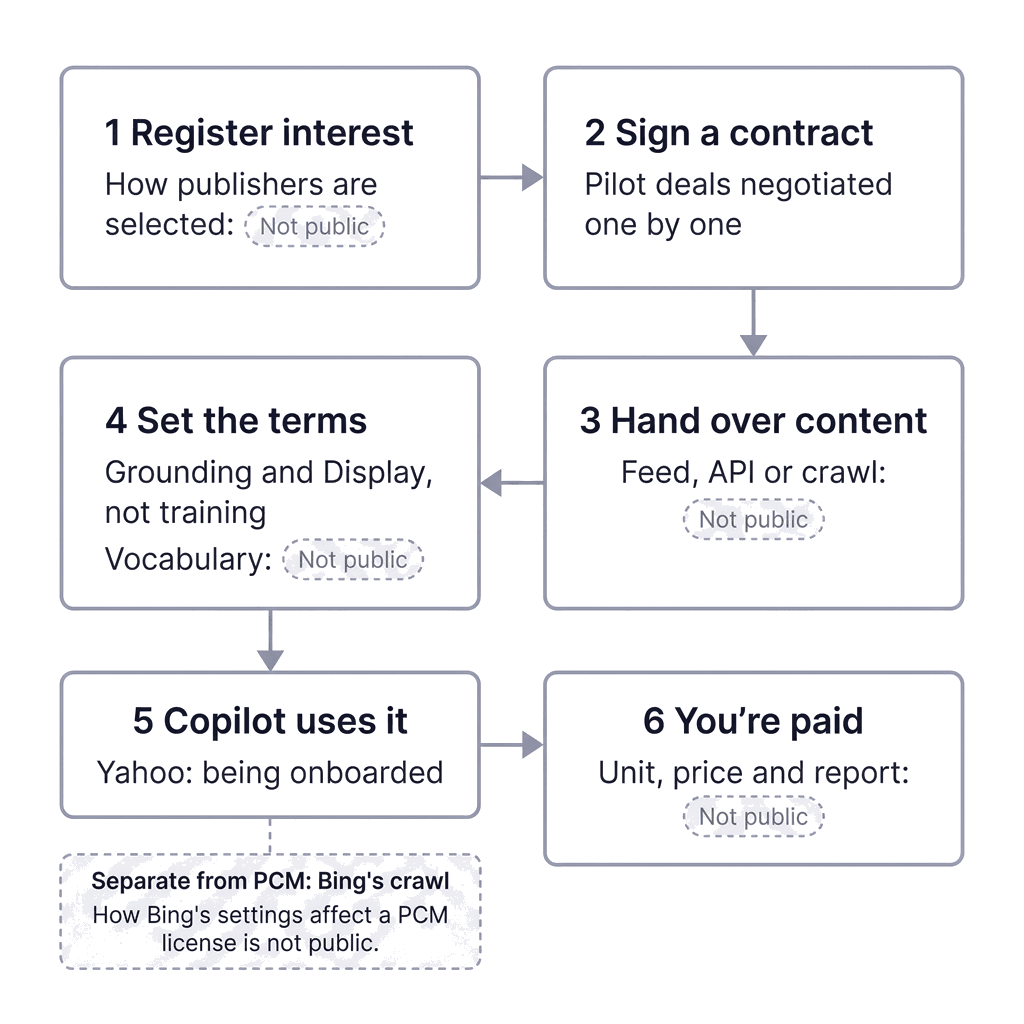
Microsoft PCM in six steps: you register interest, sign a contract negotiated one by one in the pilot, hand over content, set the terms (Grounding and Display, not training), Copilot uses it while Yahoo is being onboarded, and you're paid. How publishers are selected, how content is handed over (feed, API or crawl), the terms' vocabulary, and the unit, price and report are not public. Beside step 5, separate from PCM, is Bing's crawl; how Bing's settings affect a PCM license is not public either.
Microsoft PCM, from an interest form to a payment.
Text version

Microsoft PCM in six steps: you register interest, sign a contract negotiated one by one in the pilot, hand over content, set the terms (Grounding and Display, not training), Copilot uses it while Yahoo is being onboarded, and you're paid. How publishers are selected, how content is handed over (feed, API or crawl), the terms' vocabulary, and the unit, price and report are not public. Beside step 5, separate from PCM, is Bing's crawl; how Bing's settings affect a PCM license is not public either.

PCM in four numbers
2
versions of Copilot PCM started with, enterprise and consumer [1]
7
US publishers Microsoft names as co-designers, "among others" [1]
4
publishers that confirmed their deals in late 2025 [15, 16, 17, 18]
1
buyer beyond Copilot that Microsoft names: Yahoo, which it is onboarding [1]
Who has signed, and who has been paid

Seven publishers named, four confirmed. No payment is public.

People Inc. has signed a deal with Microsoft to partner as one of a select group of premier publishers to build Microsoft’s Publisher Content Marketplace (PCM).

IAC, People Inc's owner, third-quarter 2025 results

Microsoft names seven US co-design publishers, "among others": The Associated Press, Business Insider, Condé Nast, Hearst Magazines, People Inc, USA TODAY Co. and Vox Media [1]. Four confirmed their deals in late 2025: Gannett, in its third-quarter results; People Inc, through its owner IAC; the AP, to Digiday; and Business Insider, in a staff memo.

Microsoft publishes no count of publishers. Neither Microsoft nor a publisher has said a payment was made.

What it takes on your site

PCM documents nothing on your site. FORA is a file and an edge function.

PCM's column is what Microsoft documents. Microsoft Learn's search returns no page on PCM, and Microsoft's help and webmaster sites carry no publisher integration guide for it.

PCM

  • How content gets in: through "the pipes" Microsoft built [12]. Feed format, ingestion API, CMS plugin or crawler: Not public
  • DNS and CDN: no change documented. The product page promises "a single, trusted path to make content available for AI use cases while preventing unwanted crawling" [2]. It doesn't say how.
  • Who gets in: Microsoft onboards the other buyers, such as Yahoo [1]. How your contract limits them: Not public PCM documents no bot rule, so what your CDN blocks stays your decision.
  • What a bot gets back: PCM documents no answer to a bot, neither a redirect nor a payment-required response.
  • Logs: none documented. You get "usage-based reporting" [1].

FORA

  • How content gets in: it stays on your site. The Exchange reads your sitemap, and you set terms in its operator's console. Or you push the catalog to it (What is FORA?).
  • DNS and CDN: you serve one file that names your Exchanges, and install the edge function on your CDN (Deployment).
  • Who gets in: you choose the paths you license. There, the edge function refuses AI bots that come without a signed link. Readers and search crawlers pass as before [6].
  • What a bot gets back: a refusal that tells the bot where to buy [8].
  • Logs: each refusal states its reason, the same reason the edge function logs [8]. The Exchange records each sale.
Search traffic

Bing's crawl is separate from PCM, and it feeds Copilot too

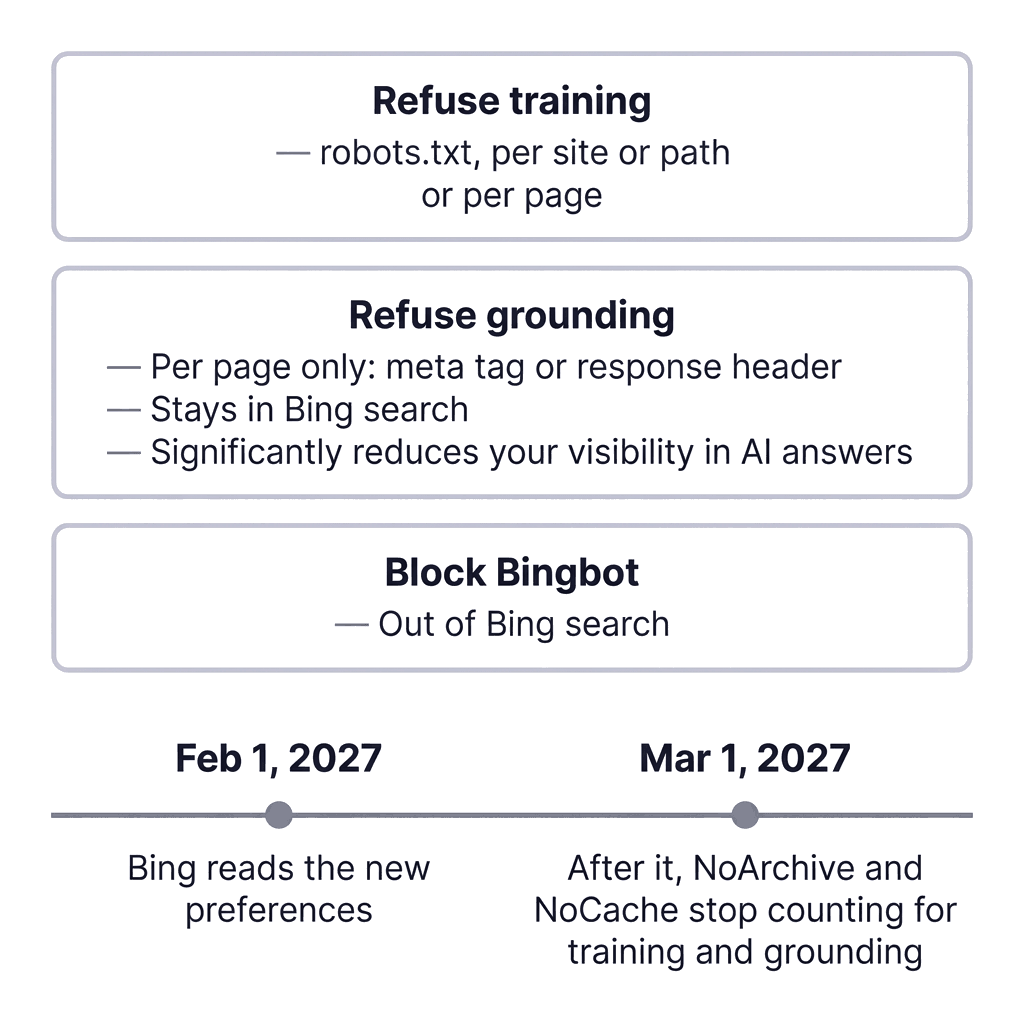
Bing's crawl feeds "web-grounded responses in Bing, Copilot, and Microsoft 365" (Bing). From February 1, 2027, Bing reads new preferences as it crawls: one for AI training and one for grounding, both apart from search. "These settings govern use of content, not crawl access." How any of them affects a PCM license: Not public FORA's rules generator writes Bing's training refusal on every setting, and its grounding refusal only if you leave AI search.

Three Bing settings: refuse training in robots.txt per site or path, or per page; refuse grounding per page only, with a meta tag or response header, which keeps you in Bing search and significantly reduces your visibility in AI answers; or block Bingbot and drop out of Bing search. Bing reads the new preferences from February 1, 2027, and after March 1, 2027, NoArchive and NoCache stop counting for training and grounding.
What each of Bing's settings does.
Text version

Three Bing settings: refuse training in robots.txt per site or path, or per page; refuse grounding per page only, with a meta tag or response header, which keeps you in Bing search and significantly reduces your visibility in AI answers; or block Bingbot and drop out of Bing search. Bing reads the new preferences from February 1, 2027, and after March 1, 2027, NoArchive and NoCache stop counting for training and grounding.

Where PCM is ahead

What PCM does that FORA doesn't

The differences, question by question

Eight questions a publisher asks of any licensing deal

PCM does the first four inside one company's contract; FORA does them with a public file and signed messages. The last four compare like for like.

The questionMicrosoft PCMFORA
How do you say what's for sale? In your PCM contract: "publisher-defined content and license terms". Nothing on your site says so to anyone else [2]. Your FORA file names the Exchanges that sell your content, and you set terms per resource in your operator's publisher console [7].
How does a buyer find your content? "AI builders discover and license content for specific grounding scenarios" [1]. How: Not public An agent asks your Exchange, or a Broker. Each Broker operator chooses its search, and each agent chooses its Broker [10].
Who is the buyer, provably? Copilot, Microsoft's own product. Microsoft is "beginning to onboard" Yahoo [1]. Agent identification: Not public Each request carries a signature, checked against the signer's published key (Web Bot Auth, the IETF working group's -00 draft) [11].
What lets a given use happen? The contract. Pilot contracts were negotiated one by one; the standard contract was not final in February 2026 [12]. A signed offer the agent accepts and signs, and a link that expires, checked at your CDN [7].
Who sets the price, in what unit? Paid "on delivered value" [1]. The unit and who sets the number: Not public You: free, per unit (an access, a token, a page) or a flat fee, signed on each offer. Fixed at the sale, by design [9].
How does money move? For Copilot's use, Microsoft is the buyer [1]. Who pays for any other partner's use, when, and any minimum: Not public Outside the protocol. See About FORA.
What do you see? "usage-based reporting" on how content is "valued, cited, and used" [1, 2]. What a report contains: Not public The operator's console: your sales, with gross, fee and net. It is each operator's own; no protocol call returns your sales [4].
What if the numbers are wrong? No dispute process is described [1, 2, 12]. Defined in the protocol, handled under your operator's rules. See About FORA.
Running both

Both on one site today

Works today

For AI answers, not training. Credit the article.
restrictions:
FUNCTION permitted: ai-input prohibited: ai-train
obligations:
ATTRIBUTION, on use: "Show the article as a cited link to news.example.com"
pricing:
PER_UNIT unit: accesses rate: "0.05" currency: USD
Grounding and Display as one FORA term.

The difference is the price. PCM pays "on delivered value", by a unit Microsoft hasn't published [1]. On FORA, the price is signed on the offer before the sale. An agent that isn't a PCM buyer finds this term through the file that names your Exchanges.

Doesn't fit

Paying FORA sales through PCM. PCM is a marketplace with Microsoft as the payer, and no payment service for others. On FORA, the Exchange operator bills the buyer and pays you (What is FORA?).

Declaring PCM in a file. Microsoft publishes no file or tag that says a site is in PCM. Asked whether RSL could work with PCM, Microsoft's spokesperson didn't have "anything specific to share today" (The Verge, February 3, 2026). Say it on your licensing page, in words.

What to do

If you're in PCM, or weighing it

  1. Ask how you join. Microsoft's product page has an interest form, and doesn't say how publishers are selected.
  2. Ask for the unit and the price. Microsoft hasn't published what it pays per use, or who sets the number. Ask both, in writing.
  3. Ask how your content gets in. Microsoft hasn't published the route: a feed, an API or a crawl. Ask what you send, how often, and who keeps it up to date.
  4. Ask what the report shows. Microsoft promises insight into how content is "valued, cited, and used" [2]. Ask for a sample report.
  5. Ask how Bing's settings affect your license. If you refuse grounding in Bing, do you lose PCM money? If you're in PCM, can you still refuse it? Ask before you choose a setting.
  6. Sell to other agents too. Name your FORA Exchanges in fora.json and put a grounding term with a citation duty on your articles. FORA itself is free, open-source software. For the publisher console's fees, see About FORA.

Sources

Sources are checked on the date of publication.

Microsoft

  1. Building toward a sustainable content economy for the agentic web Microsoft Advertising
  2. Publisher Content Marketplace Microsoft Advertising, served on Microsoft's preview host (preview-about.ads.microsoft.com)
  3. Your content, your choice: clearer preferences for training and grounding Bing

FORA

  1. Publisher onboarding FORA documentation
  2. Deployment FORA documentation
  3. Bot detection FORA documentation
  4. What is FORA? FORA documentation
  5. Edge function overview FORA documentation
  6. Licensing terms FORA documentation
  7. Broker FORA documentation
  8. Authentication FORA documentation

Press, filings and others

  1. Q&A: Nikhil Kolar, vp Microsoft AI Digiday
  2. Introducing Yahoo Scout Yahoo
  3. Google's AI payment pilot vs. Cloudflare and Microsoft models Search Engine Journal
  4. Gannett announces third quarter 2025 results Editor and Publisher
  5. Third quarter 2025 results IAC
  6. Associated Press deal cements Microsoft's quiet rise in AI licensing Digiday
  7. Business Insider joining Microsoft content marketplace Talking Biz News
  8. Microsoft's Publisher Content Marketplace The Verge

Put a price any agent can read on your content

FORA is an open protocol and free, open-source software. Sell through any FORA marketplace, several of them, or your own: you set terms and a price per resource, and each Exchange signs your offers.

Licensing terms Run your own marketplace All content marketplaces What FORA takes on your CDN