ProRata.ai licenses your articles into its own answer engine, Gist, and pays you from a pool by how much of each answer your content supplied. FORA lets AI agents, software that fetches content for an AI system or its user, buy each access at the terms and price you set.
Updated
| ProRata.ai and Gist | FORA | |
|---|---|---|
| Money | ||
| Who pays you, and when | ProRata itself, monthly, by bank transfer once you're owed more than $1,000. Its Gist Ads network ended on 2026-09-01; Gist Answers still runs. ProRata hasn't said what funds the pool since [1, 2]. | Your Exchange operator, under its own terms. See About FORA. |
| Fees | A share of a pool, not a rate: see How you're paid [1]. | No Exchange fee at FORA's publisher console, beyond the payment system's. See About FORA. |
| What you see | A monthly statement, and per article: answers it was used in, its average attribution, citation clicks. Not the month's total revenue or answer count [1, 3]. | Each sale in your operator's console: gross, the Exchange fee and net, and a check of both signatures [9]. |
| Contract | ProRata's online MSA, accepted on a web form. Non-exclusive. ProRata can change it; if you object, you can only end it [1]. | Your agreement with your Exchange operator. Your terms go into each offer the Exchange signs [10]. |
| Status | Live "150+" publishing partners, by ProRata's count. No payout total published [4]. | Live See About FORA. |
| Your stack | ||
| DNS | No change [3]. | No record to add [9]. |
| CDN | No code. Cache rules must keep the feed working, and you purge the cache after a correction [3]. | A drop-in edge function. The rest depends on your own setup; FORA adds to what you run rather than replacing it. |
| Firewall and bot shield | An allow rule for ProRata's crawler. Its user agent and IP ranges aren't published: ask ProRata [3]. | Leave your licensed paths and your discovery file to the edge function, or keep your bot product on and let signed requests and the file through [11]. |
| Your site and CMS | The WordPress plugin or one script tag. Posts only, by default. How other CMSs get in isn't documented [3, 4]. | One discovery file on your site, and a sitemap the operator imports your pages from [9]. No WordPress plugin. |
| Search traffic | Gist blocks no bot [3]. | Googlebot, Bingbot and Applebot always pass [11]. See Search traffic, below. |
| Upkeep | WordPress's scheduler must run, or nothing is sent. Removals go by email [3]. | The operator imports your pages on a schedule. Editing your discovery file needs no redeploy [9]. |
| Leaving | End the MSA. Content already ingested stays until you email the URLs [1, 3]. | Delete the edge function from your CDN. |
Its engine splits each Gist answer into claims, finds the sources that support them, and divides a pool of half its net revenue by those shares.
You set the price, the unit and the terms for each resource, and your Exchange signs each offer. Any agent your terms allow can buy on them, and each purchase is a signed record.
ProRata's contract is non-exclusive, so you can sell through FORA on the same site. Gist needs its WordPress plugin or a script tag.
Answers can also draw on sources outside the partner pool, such as Wikipedia (user guide). The contract doesn't say where their share goes (MSA §5).
ProRata retired its Gist Ads network "on September 1, 2026" (Gist Ads). Only the ad network ended: Gist Answers, the answer engine on publishers' sites, still runs (Gist Answers). ProRata hasn't said what funds the pool since. It offers its attribution engine to AI platforms "through direct engagement with the team" (Products) and names no platform customer.
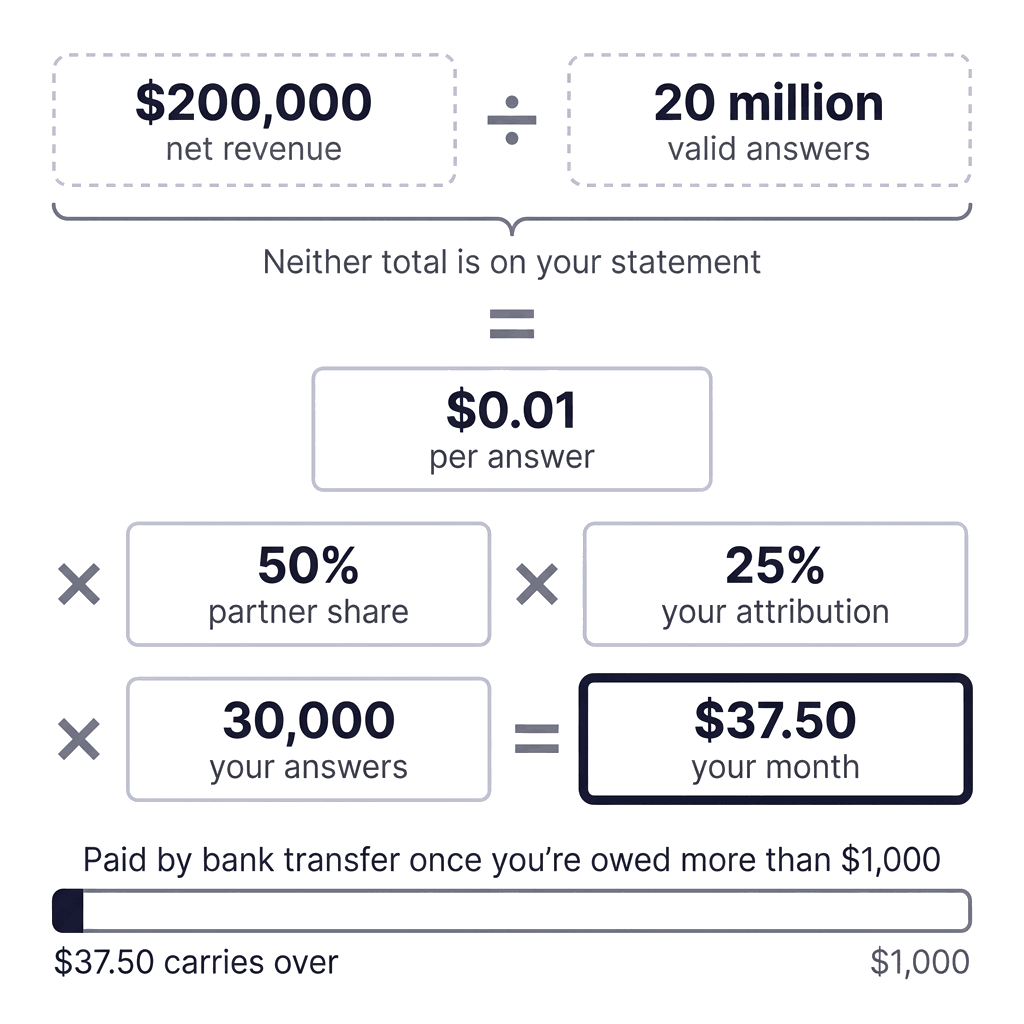
Say a month brings ProRata $200,000 in net revenue and 20 million valid answers: each answer carries $0.01, and neither total is on your statement. Your month is $0.01 × 50% partner share × 25% average attribution × 30,000 answers = $37.50, which carries over, since ProRata pays by bank transfer only once you're owed more than $1,000.
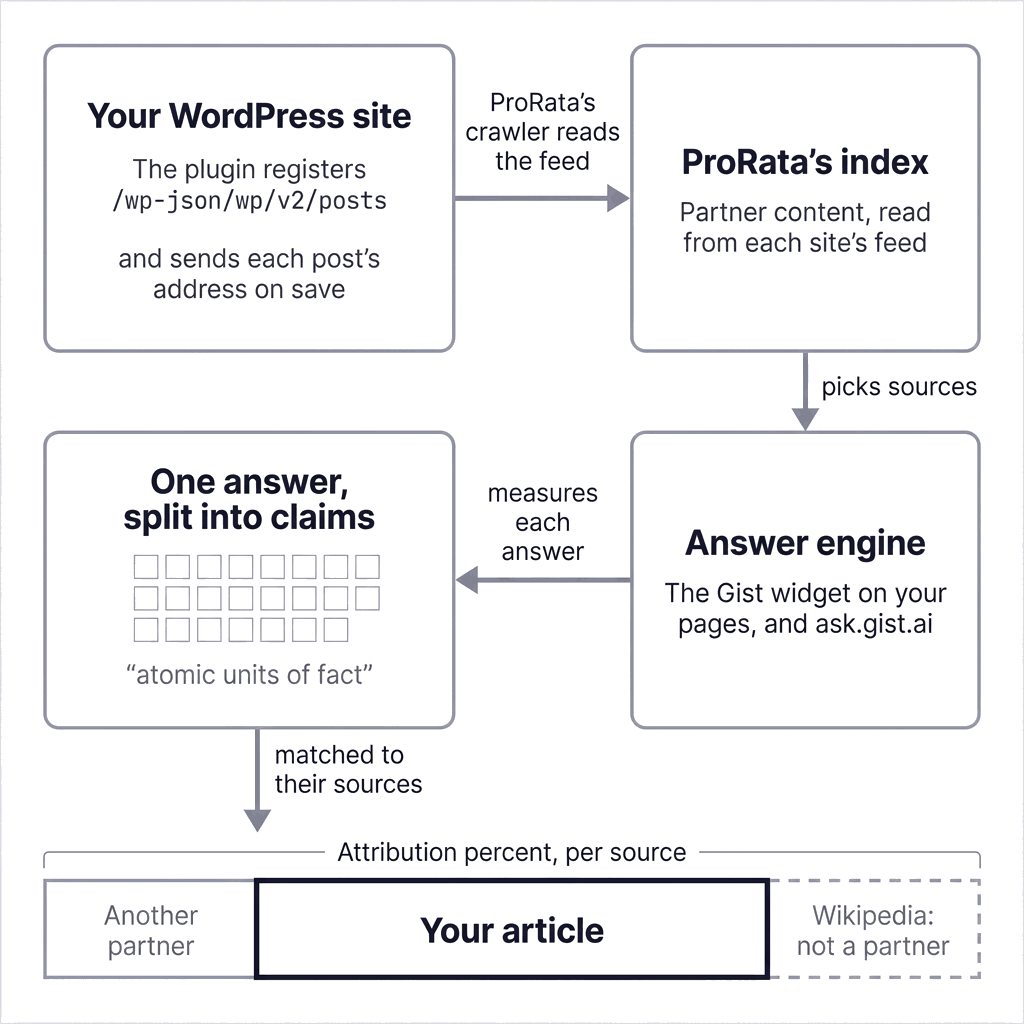
The WordPress plugin registers your posts feed, /wp-json/wp/v2/posts, and sends each post's address on save; ProRata's crawler reads the feed into ProRata's index of partner content, and the answer engine picks sources for the Gist widget on your pages and for ask.gist.ai. Each answer is split into claims, "atomic units of fact", matched to their sources to give an attribution percent per source: another partner, your article, or Wikipedia, which is not a partner.
The Gist Answers page counts "150+" publishing partners and "1,600+" licensed titles (vendor's own data, Gist Answers). No payout total is published.
Readers and search crawlers reach your site as today. Gist needs no DNS change and no code on your CDN, but it touches your CMS, your cache rules and your bot protection. It runs through the WordPress plugin or one script tag; how Gist ingests a site that doesn't run WordPress isn't documented, so ask ProRata.
ProRata is ahead on reporting a share of each answer and on an audit right; FORA on setting your own price. The first four rows compare different jobs: ProRata doesn't set out to sell to outside AI companies.
| The question | ProRata.ai and Gist | FORA |
|---|---|---|
| How do you say what's for sale? | You click to accept the MSA, which grants fixed uses: answers in ProRata's products, and attribution. Nothing on your site says so to anyone else [1]. | Your fora.json names the Exchanges that sell your content; you set terms per resource in the Exchange operator's console [9, 10]. |
| How does a buyer find your content? | No outside buyer does. ProRata's engine picks sources from its own index of partner content and doesn't publish how it picks them. On your widget, "Answers come from your content first" [4]. | From your Exchange, or through a Broker (how a Broker orders offers) [13]. |
| Who is the buyer, provably? | There is no outside buyer. ProRata's crawler publishes no user agent or IP ranges [3]. | Each request carries a signature, checked against a key the buyer publishes on its own domain (Web Bot Auth, the IETF working group's -00 draft for signed bot requests) [10]. |
| What lets a given use happen? | The MSA grant, for every answer ProRata generates during the contract [1]. | An offer the Exchange signs and the agent accepts, and a signed link that expires, checked at your CDN [10]. |
| Who sets the price, in what unit? | ProRata: 50% of net revenue, split per valid answer by attribution. The online MSA sets the same split for every partner who accepts it. ProRata can change the terms [1]. | You: free, per unit (pages, text tokens, seconds or your own) or a flat fee, signed on each offer. No revenue-share price, by design: a share is a free term shown to agents that state the deal's scope, with a reporting duty (Revenue share). |
| How does money move? | ProRata pays by bank transfer, monthly, once you're owed more than $1,000 [1]. | Outside the protocol. See About FORA. |
| What do you see? | A monthly statement per partner, publication and article (above a minimum number of answers): answers, average attribution, revenue. Not the month's total revenue or answer count [1]. | The operator's console: each sale with gross, fee and net, and a check of both signatures. The console is each operator's own; no protocol call returns your sales [9]. |
| What if the numbers are wrong? | An independent inspection of one year of records, then the courts of Los Angeles County [1]. | Defined in the protocol, handled under your operator's rules. See About FORA. |
Gist answers as FORA offers. Gist sells agents nothing: its terms forbid access by any "agent or other automatic device" (Terms of Use). A Gist answer is also written when someone asks, and FORA sells resources that exist before the sale (What is FORA?). ProRata offers no payment service to others either, so an Exchange can't settle through it.

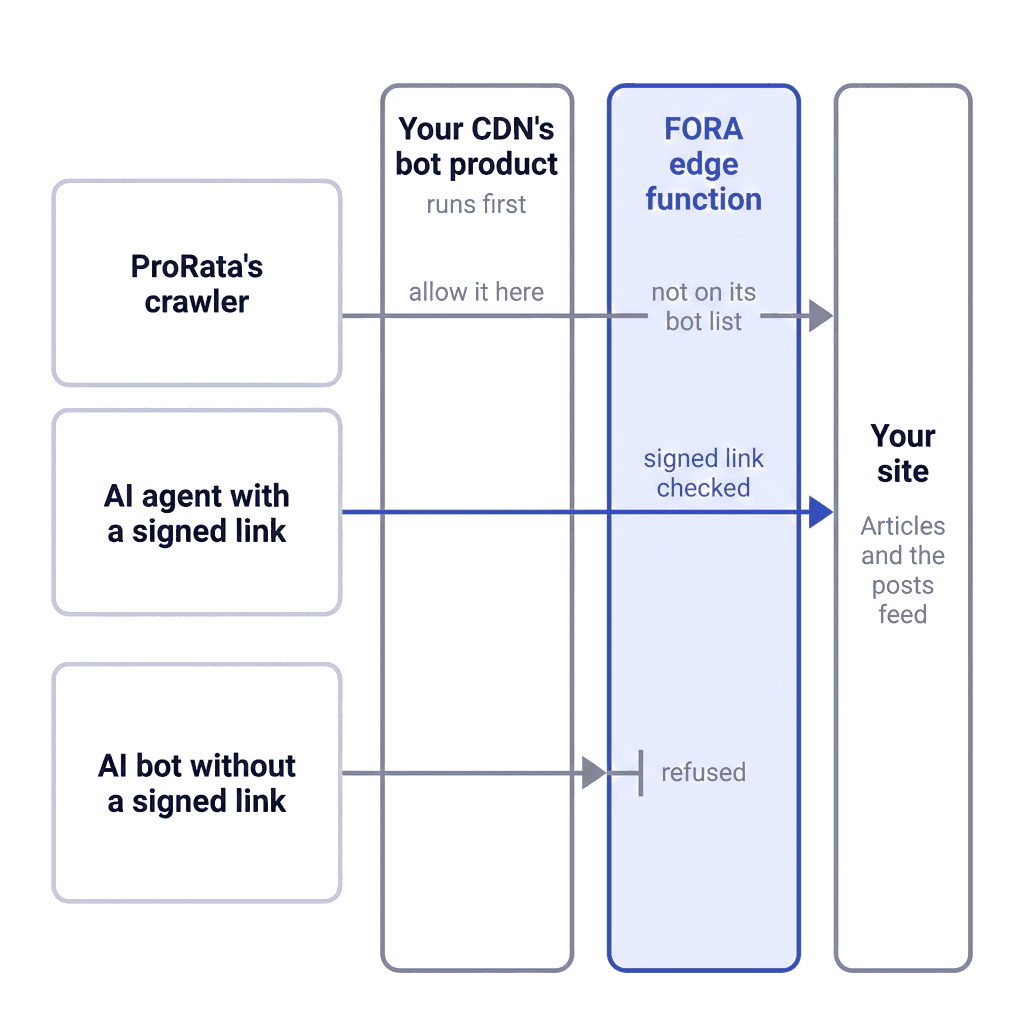
Your CDN's bot product runs first and the FORA edge function second: ProRata's crawler gets through if you allow it at your CDN, because it is not on the edge's bot list; an AI agent with a signed link passes after the edge checks the link; and an AI bot without a signed link is refused at the edge.
fora.json, set your price per resource, and cover the posts feed at the edge.Sources are checked on the date of publication.
FORA is an open protocol and free, open-source software. Sell through any FORA marketplace, several of them, or your own: you set terms and a price per resource, and each Exchange signs your offers.