TollBit runs a paywall for AI bots on a subdomain of your site, and your CDN sends known AI bots there. FORA lets an AI agent buy each page under an offer your Exchange signs, and fetch it from your own CDN.
Updated
The facts a revenue team and an engineering lead act on.
| TollBit | FORA | |
|---|---|---|
| Money | ||
| Who pays you, and when | TollBit, through Stripe, early each month, in US dollars [1, 2]. | Your Exchange operator, under its own terms. See About FORA. |
| Fees | You keep your full rate. The buyer pays a fee on top; its size isn't published [3]. | No Exchange fee at FORA's publisher console, beyond the payment system's. See About FORA. |
| What you see | Daily bot analytics, and each sale: agent, page, price [3, 4]. | Each sale in your operator's publisher console, with totals and a daily CSV. No bot-traffic report [26]. |
| Contract | A license between you and each buyer; TollBit isn't a party [5]. New York law [6]. No dispute call. | Your agreement with your Exchange operator. Your terms go into each offer the Exchange signs [26, 27]. Disputes: see About FORA. |
| Status | Live A publisher reports revenue [36]. No TollBit page names a big AI company as a buyer. | Live See About FORA. |
| Your stack | ||
| DNS | A TXT record, and an NS record that hands a subdomain to TollBit [7]. | No record to add [26]. |
| CDN | One forwarding rule for 69 AI user agents [8]. Guides for 12 platforms [9]. | A drop-in edge function. The rest depends on your own setup; FORA adds to what you run rather than replacing it. |
| Firewall and bot shield | An allow rule for TollBit's fetcher in every layer [7]. | On most CDNs they run first, so they must let signed requests and your two licensing files through. Keep them: the edge function knows AI agents mainly by the name they send [26, 28]. |
| Your site and CMS | No change. TollBit fetches, cleans and serves the page. Your HTTP logs, readers' requests included, go to TollBit [1, 4]. | Serve one file, fora.json, from your site. The operator imports your pages from your sitemap [26]. |
| Search traffic | Googlebot and Bingbot aren't on TollBit's list; they reach your site as today [8]. | Googlebot, Bingbot and Applebot always pass [28]. See Search traffic, below. |
| Upkeep | On most platforms, update the bot list by hand each quarter [10]. | Change your Exchanges by editing your FORA file, with nothing to redeploy [29]. |
| Leaving | No offboarding page. You can end the terms only with no active license [5]. | Delete the edge function from your CDN. |
Your CDN spots AI bots by the name they send and hands them to TollBit, which charges per page at your rate.
An agent signs each request, buys under a signed offer, and fetches with a signed link, which your CDN checks. You price by use, country, buyer type and unit.
A Broker would call TollBit with each agent's own TollBit account and show TollBit's rates beside your FORA offers.

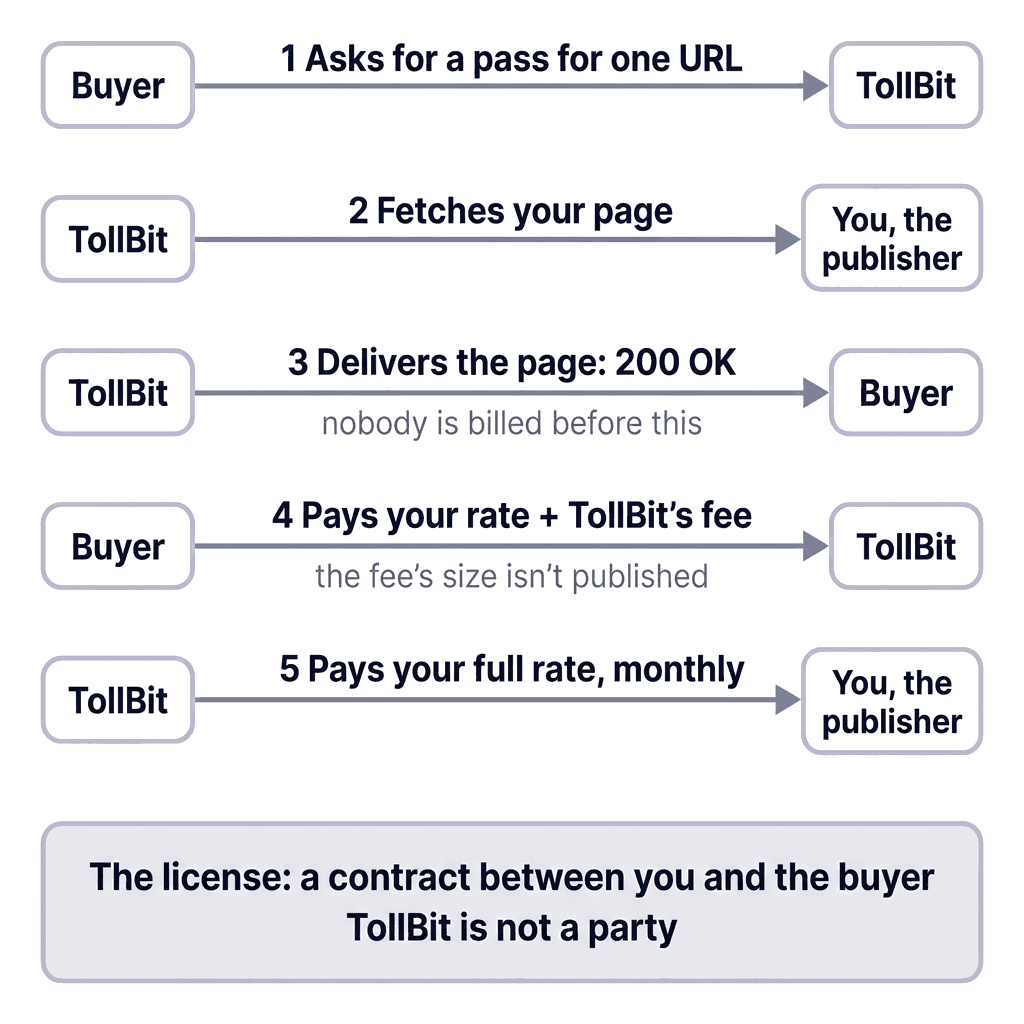
The buyer asks TollBit for a pass for one URL; TollBit fetches your page and delivers it with 200 OK, and nobody is billed before that. The buyer then pays your rate plus TollBit's fee, whose size isn't published, and TollBit pays you your full rate monthly; the license is a contract between you and the buyer, and TollBit is not a party.
[TNL Mediagene] has begun generating initial revenue from AI buyers.
TollBit counts sites that use it, whether or not they have rates switched on. The count rose from "over 200 publisher sites" in October 2024 (Series A) to the CEO's nearly 7,000 in April 2026. The homepage says "Trusted by over 10,000 sites" (vendor's figure, TollBit).
TollBit's 2024 funding post says it "has secured partnerships with the first AI companies", without naming them [14]. No TollBit page or release names OpenAI, Google, Microsoft, Meta, Amazon, Anthropic or Perplexity as a buyer.
Readers and search crawlers reach your site as today. The setup is five steps on your DNS, CDN and security layers, and nothing in your CMS.

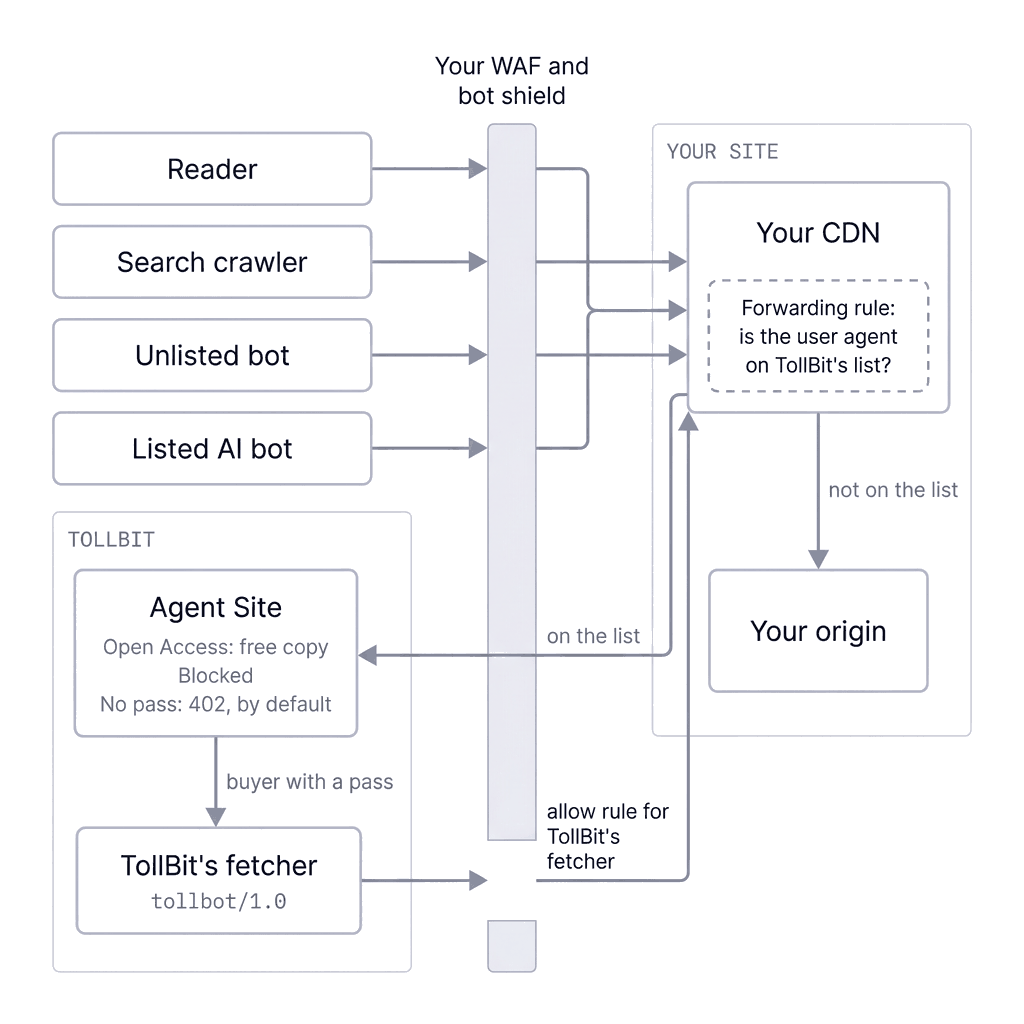
Readers, search crawlers, unlisted bots and listed AI bots all reach your CDN, where a forwarding rule sends only the bots on TollBit's list to TollBit's Agent Site; that site gives a free copy (Open Access), blocks the bot, or by default answers 402 without a pass, and everything not on the list reaches your origin. TollBit's fetcher (tollbot/1.0) then pulls the page for a buyer with a pass through your CDN to your origin, and it gets through your WAF and bot shield only by an allow rule for TollBit's fetcher.
TollBit is ahead on what you see; FORA on how you can price and on who can check a pass. The first three rows compare different jobs. Both license your pages to AI buyers, and they can share your CDN.
| The question | TollBit | FORA |
|---|---|---|
| How do you say what's for sale? | Nowhere on your site. A forwarded bot gets a 402 by default; your rates live in TollBit's dashboard [3, 21]. | Your fora.json names the Exchanges that sell your content, and you set terms with each [27]. |
| How does a buyer find your content? | TollBit's search, which covers sites across the web and flags its own network [11]. How the index is built isn't documented. | From your file and your Exchange, or through a Broker [27, 31]. No index spans the network. |
| Who is the buyer, provably? | Bots: by user agent, from a list of 69 [8]. Buyers: a TollBit account, bound into each pass, which only TollBit can check [1, 2, 4]. | A signature on each request, checked against the buyer's published key [32]. The edge also matches the names bots send [28]. |
| What lets a given use happen? | A pass for one URL, five minutes, one use, checked by TollBit alone [2, 4]. | A signed link that expires and can be bound to the agent's key. Any edge with the Exchange's public key can check it [27, 33]. |
| Who sets the price, in what unit? | You: per 1,000 pages, per license type, by bot, page, keyword, time and directory. US dollars [2, 3]. | You: free, per unit (pages, text tokens, seconds or your own) or flat, limited by use, country and buyer type, with caps. A currency per price [27, 30]. |
| How does money move? | Through Stripe, monthly. You keep your full rate; the buyer pays an unpublished fee on top [1, 3]. | Outside the protocol. See About FORA. |
| What do you see? | Daily bot analytics, and each sale: agent, page, price [3, 4]. | Each sale, in the publisher console your Exchange operator runs [26, 27]. No protocol call returns your sales. |
| What if the numbers are wrong? | No dispute call, and no charge without a delivered page [1]. Then New York courts, or arbitration with TollBit [5, 6]. | Defined in the protocol, handled under your operator's rules. See About FORA. |
TollBit's docs ask "Can I use another AI marketplace like TollBit in parallel?" The answer: "Yes, this is dependent on how you set up your log exports and bot redirect policies" (Platform architecture). Order your CDN rules like this.
tollbot/1.0 is one. Add it to the edge function's allow list, beside your search crawlers (FORA Server's edge configuration).On Cloudflare Enterprise, "Snippets execute earlier in Cloudflare's traffic sequence than Worker routes", so TollBit's rule runs first. On other plans "CloudFlare only runs one Worker per route", so your engineers combine TollBit's rule and FORA's edge function in one Worker (Cloudflare; Composition).
A Broker would call TollBit's API with each agent's own TollBit account, never one of its own, as TollBit lets a platform act for a buyer (Platform overview, §4.3). An Exchange would sign each TollBit rate as a FORA offer, so the agent sees both offers and decides. How a Broker orders offers is on the hub.
Settling a FORA sale through TollBit. TollBit's API bills the calling account at TollBit's own rates, even for usage the buyer reports itself. It has no call that bills a price another Exchange set (Content).

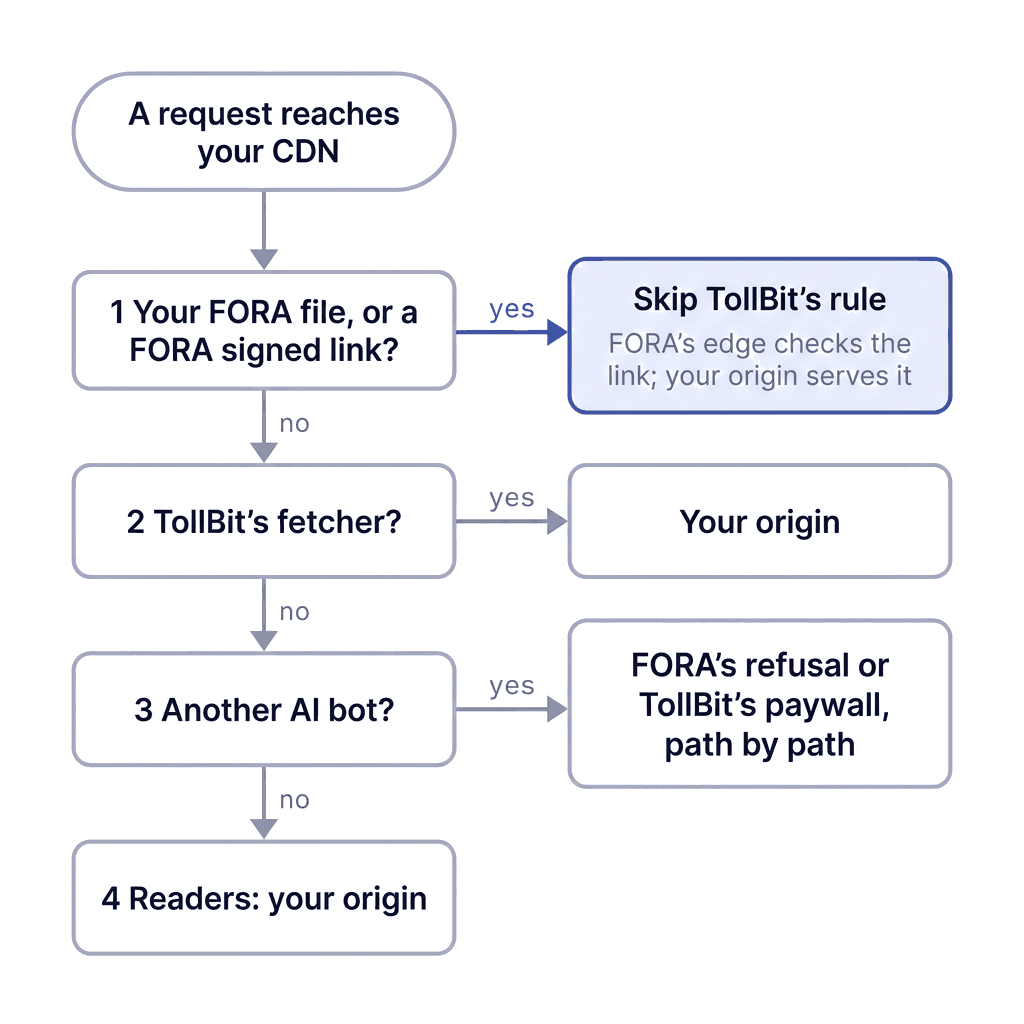
Your CDN asks four questions in order: a request for your FORA file or with a FORA signed link skips TollBit's rule, and FORA's edge checks the link before your origin serves it; TollBit's fetcher goes to your origin; another AI bot gets FORA's refusal or TollBit's paywall, path by path; and readers go to your origin.
fora.json, with terms TollBit's rate card has no field for: a price by country or buyer type, or per text token (Rates).Sources are checked on the date of publication.
FORA is an open protocol and free, open-source software. Sell through any FORA marketplace, several of them, or your own: you set terms and a price per resource, and each Exchange signs your offers.