Resources · Content marketplaces · Perplexity

Perplexity says its Publishers' Program and Comet Plus pay the publishers it signs. With FORA, any AI company can buy at your price.

Perplexity's Publishers' Program shared ad revenue from July 2024. Comet Plus, Perplexity's own program, shares subscription revenue with the publishers it signs, by how Perplexity's products use their sites. FORA lets any AI agent buy each access at the price you set, and records each sale.

Updated

At a glance

Perplexity and FORA, side by side

The facts a revenue team and an engineering lead act on.

Perplexity Comet PlusFORA
Money
Who pays you, and when Perplexity says it pays, from a pool of Comet Plus revenue, by its own counts. Schedule, threshold and currency: Not public [1]. Your Exchange operator, under its own terms. See About FORA.
Fees Perplexity keeps "a small portion" for compute; 20% in press reports [1, 12]. No Exchange fee at FORA's publisher console, beyond the payment system's. See About FORA.
What you see No Comet Plus statement format is published [1, 2]. 2024 partners got analytics on how Perplexity cites them [3]. Each sale, in your operator's publisher console, with gross, the Exchange fee and net (Publisher onboarding).
Contract A private contract, after an email to Perplexity. No standard agreement is published [1]. Your agreement with your Exchange operator; your terms go into each offer it signs [21].
Status Not public Comet Plus isn't on Perplexity's pricing page. Whether it still pays out isn't public. Live See About FORA.
Your stack
DNS No change in Perplexity's docs [5]. No record to add [20].
CDN No code in Perplexity's docs [5]. A drop-in edge function. The rest depends on your own setup; FORA adds to what you run rather than replacing it.
Firewall and bot shield An allow rule that matches each Perplexity crawler to its own IP ranges [5]. Keep your bot protection, and let AI agents that name themselves reach the edge function. Or let signed requests and your discovery file through (Bot detection).
Your site and CMS No feed, file or API. How your paywall lets a Comet Plus subscriber in: Not public [5, 6]. One file that names your Exchanges, and a sitemap the operator imports your pages from [20].
Search traffic PerplexityBot builds Perplexity's search index and follows robots.txt [5, 6]. Googlebot, Bingbot and Applebot always pass [22]. PerplexityBot is refused on licensed paths by default. See Search traffic, below.
Upkeep A scheduled job to refresh Perplexity's IP ranges, which Perplexity updates regularly [5]. Change your Exchanges by editing your discovery file, with nothing to redeploy [20].
Leaving Not public. Delete the edge function from your CDN.
The short answer

Perplexity buys for itself. FORA lets any agent buy.

Perplexity is the buyer.

Comet Plus is meant to share Perplexity's own revenue with the publishers it signs, for use in its answer engine, its Comet browser and Comet Assistant. No other AI company buys publisher content through its programs.

Not public
Whether Comet Plus still pays isn't public.

Comet Plus isn't on Perplexity's pricing page or plan guide. CNN, a launch partner, never got from its term sheet to a contract, its complaint says. CNN sued Perplexity on 2026-05-28.

FORA prices the access, on the same site.

You set the price, the unit and the terms for each page. Any agent can buy, and each purchase is a signed record. You can let Perplexity's search crawler in and sell to other agents through FORA on one site.

How Comet Plus is meant to pay you

From a subscriber's payment to your share, in seven steps

Comet is Perplexity's browser, and Comet Assistant is its AI helper. As Perplexity describes Comet Plus:
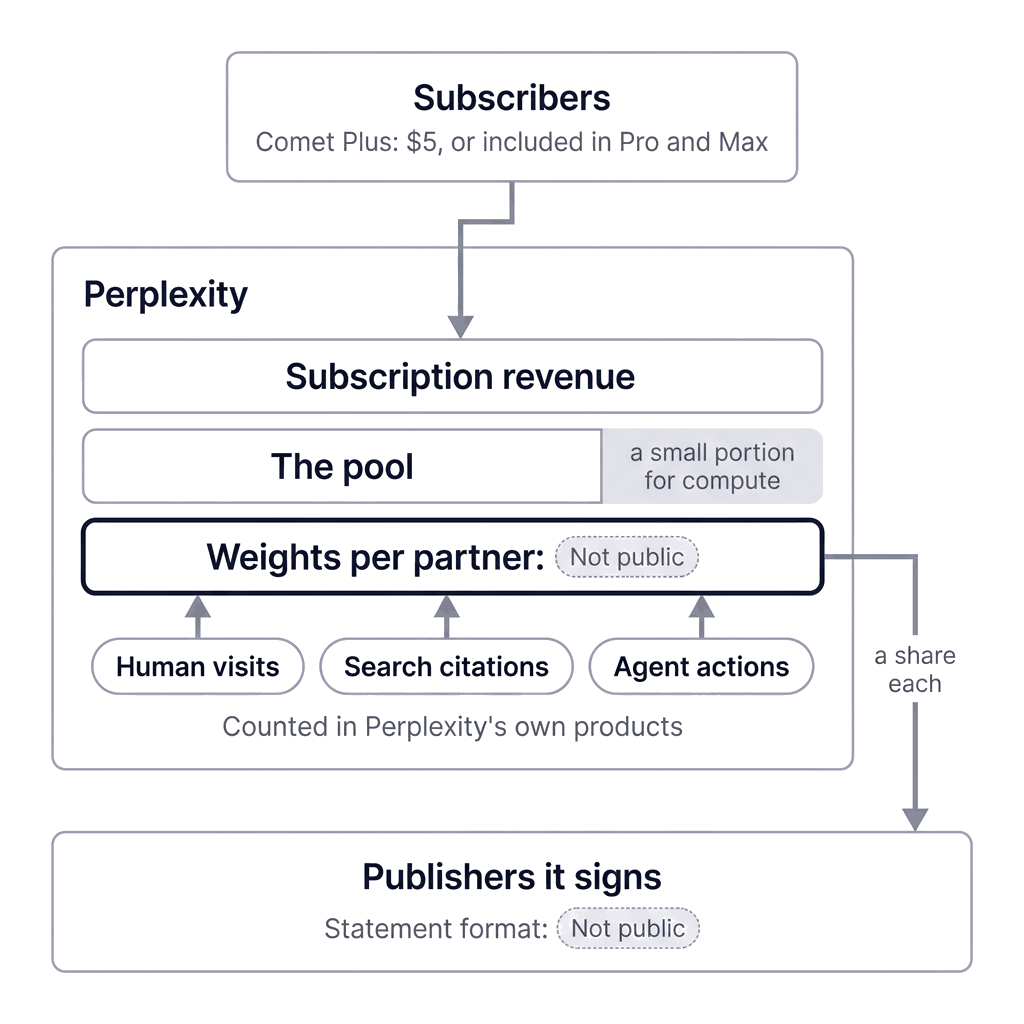
Subscribers pay for Comet Plus ($5, or included in Pro and Max); the subscription revenue becomes a pool, minus a small portion for compute, which Perplexity splits, a share each, among the publishers it signs, by weights per partner that are not public, over human visits, search citations and agent actions counted in its own products. The statement format is not public.
How Comet Plus is built to pay, as Perplexity describes it.
Text version

Subscribers pay for Comet Plus ($5, or included in Pro and Max); the subscription revenue becomes a pool, minus a small portion for compute, which Perplexity splits, a share each, among the publishers it signs, by weights per partner that are not public, over human visits, search citations and agent actions counted in its own products. The statement format is not public.

  1. You email and sign. "Publishers interested in participating can join the program by emailing us via publishers@perplexity.ai" (Introducing Comet Plus). No standard agreement is published.
  2. Subscribers pay Perplexity. "Comet Plus will be a $5 standalone subscription. Pro and Max subscribers get Comet Plus included in their memberships" [1].
  3. Subscribers reach your site. They get "direct access to the sites and content of participating publishers", and their assistants can "complete tasks on those sites" [1]. How your paywall recognizes a subscriber isn't public.
  4. Perplexity counts three kinds of traffic. Comet Plus "allocates revenue to our partners based on three types of internet traffic: human visits, search citations, and agent actions" [1]. Digiday describes the visits as "direct visits to publisher's sites by people browsing using Comet". It describes agent actions as content "used to complete tasks by Comet's AI assistant" (Digiday, published 2025-08-26). Perplexity counts all three in its own products, with no independent count described.
  5. The revenue becomes a pool. "We're distributing all of that revenue to participating publishers, minus a small portion for Perplexity's compute costs" [1]. Digiday reported that "Perplexity keeps 20% of it" and that Perplexity is "opening up a pool of $42.5 million to publishers". Perplexity's own pages give neither figure.
  6. The pool is split by weights you don't see. Asked whether one kind of use weighs more, Jessica Chan, Perplexity's head of publisher partnerships, told Digiday: "The details will be very specific to our partners, but you are thinking about it correctly." The weights aren't published.
  7. Perplexity says it pays. No schedule, threshold, currency or statement format is published.
Comet Plus in four numbers
$5
Comet Plus on its own; Pro and Max subscribers get it included [1]
3
Kinds of traffic Perplexity counts: human visits, search citations and agent actions [1]
$42.5 million
The pool Digiday reported; Perplexity's own pages don't give it [1, 12]
Not public
The weight on each kind of traffic, per partner [12]
What it takes on your site

Crawler rules, and an open question about your paywall

Perplexity's docs include no partner integration guide. Its technical guidance for site owners is its crawler page and its robots.txt help article. Perplexity's docs ask for no DNS change and no code on your CDN. Two things aren't documented: which user agent Comet sends, and how your paywall lets a Comet Plus subscriber in.

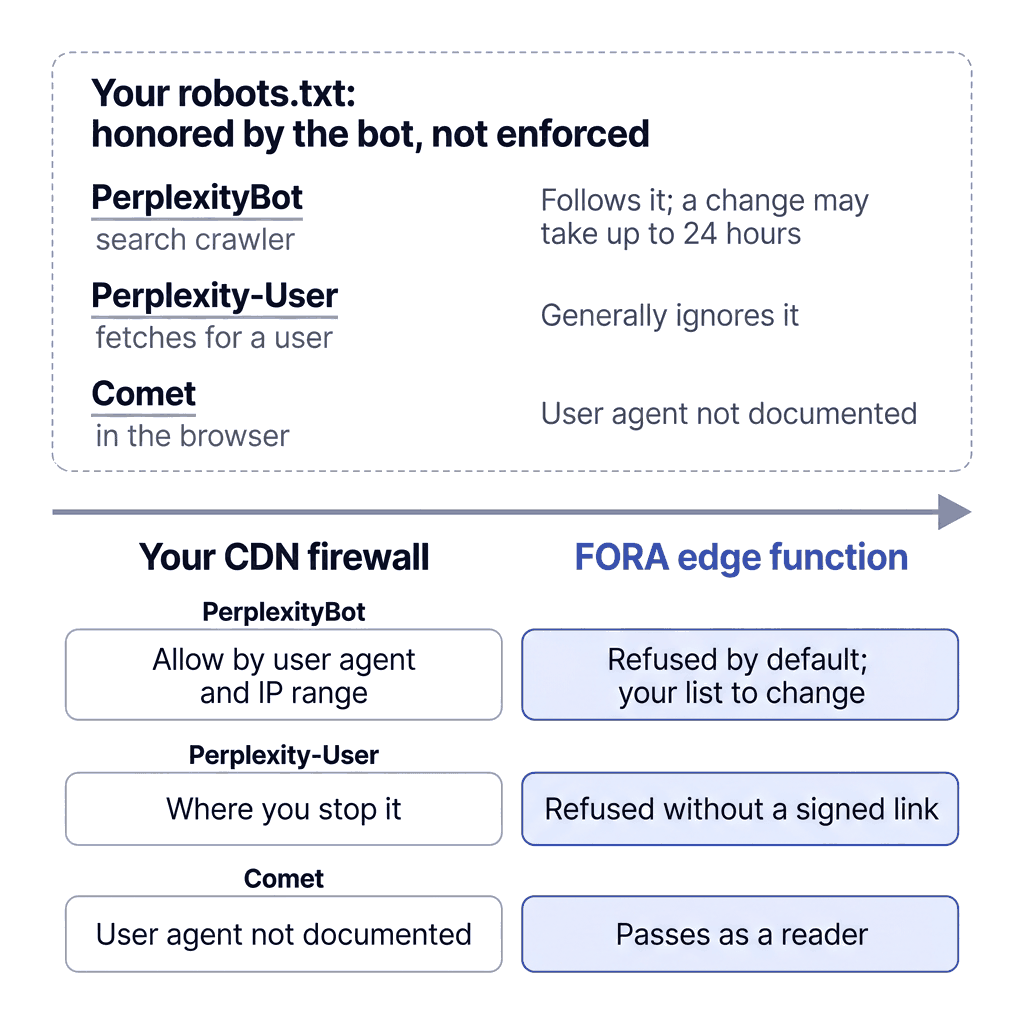
Your robots.txt stands apart from the request path: it is honored by the bot, not enforced. PerplexityBot, the search crawler, follows it (a change may take up to 24 hours), Perplexity-User generally ignores it, and Comet's user agent isn't documented. On the request path, your CDN firewall lets PerplexityBot in by an allow rule matching its user agent and IP ranges, and the FORA edge function refuses it by default, a list you can change; your firewall is where you stop Perplexity-User, and the edge refuses it without a signed link; Comet's user agent isn't documented, and it passes the edge as a reader.
Three ways Perplexity reaches your pages, and where you decide.
Text version

Your robots.txt stands apart from the request path: it is honored by the bot, not enforced. PerplexityBot, the search crawler, follows it (a change may take up to 24 hours), Perplexity-User generally ignores it, and Comet's user agent isn't documented. On the request path, your CDN firewall lets PerplexityBot in by an allow rule matching its user agent and IP ranges, and the FORA edge function refuses it by default, a list you can change; your firewall is where you stop Perplexity-User, and the edge refuses it without a signed link; Comet's user agent isn't documented, and it passes the edge as a reader.

What can go wrong

In Perplexity's own docs

Where Perplexity is ahead

What Perplexity does that FORA doesn't

The differences, question by question

Eight questions a publisher asks of any licensing deal

Perplexity runs one buyer's licensing program, and FORA is a protocol for many buyers and sellers. The first four rows compare things Perplexity doesn't set out to do for other AI companies. On the last four, Perplexity is ahead on a set pool and a smaller documented ask of your site. FORA is ahead on setting your own price and on a signed record per sale.

The questionPerplexity Comet PlusFORA
How do you say what's for sale? In a private contract. Nothing on your site states the terms to anyone else [1]. Your fora.json names the Exchanges that sell your content; you set terms per resource in the Exchange operator's console [21].
How does a buyer find your content? No outside buyer does. PerplexityBot and third-party crawlers build Perplexity's own index [5, 6]. An agent asks your Exchange, or a Broker, which returns your signed offers unchanged (how a Broker orders offers) [24].
Who is the buyer, provably? Two crawlers, known by name and published IP ranges [5]. Perplexity's crawler docs describe no request signatures, and its site serves no signing-key directory [5, 8]. Comet Assistant is meant to be "indistinguishable from you" [7]. Each request carries a signature, checked against a key the buyer publishes on its own domain (Web Bot Auth, the IETF working group's -00 draft) [21, 25].
What lets a given use happen? The contract. PerplexityBot follows robots.txt; Perplexity-User, which fetches pages for a user, "generally ignores robots.txt rules" [5, 6]. A signed offer the agent accepts and signs, and a signed link that expires, checked at your CDN [21].
Who sets the price, in what unit? Perplexity: the pool, its own cut ("a small portion"; 20% in press reports) and each partner's weights. You set no price [1, 12]. You: free, per unit (an access, or text tokens, about ¾ of a word each) or a flat fee, signed on each offer. A revenue share is a term priced at zero that only agents naming the deal see, with a reporting duty (Revenue share).
How does money move? Perplexity pays from the pool, by its own account. Schedule, threshold and currency aren't published [1]. Outside the protocol. See About FORA.
What do you see? 2024 partners got analytics on how Perplexity cites them [3]. No Comet Plus statement format is published [1, 2]. Each sale, with its signed offer and the agent's signed acceptance, in your Exchange operator's console (FORA Server's shows gross, fee and net). No protocol call returns your sales [20].
What if the numbers are wrong? No dispute process is published. Publishers' disagreements with Perplexity have gone to court; see For legal [9, 15, 16]. Defined in the protocol, handled under your operator's rules. See About FORA.

Both are ways to license Perplexity's use of your content, and they compose on your site, where you choose what each Perplexity crawler gets.

How FORA works with Perplexity

Both on one site today

Works today Live

Doesn't fit

Comet Plus as a marketplace for FORA agents. A FORA Broker presents offers that a seller signs. Perplexity licenses no partner's article to other AI companies. Its Search API sells results that its terms say are "sourced from the public internet", and the customer doesn't own them (Search API terms). There is no signed license offer to present.

Paying FORA sales through Comet Plus. Perplexity offers no payment service to anyone else. It allocates the pool from its own traffic counts.

What to do

If you're in Comet Plus, or weighing it

  1. Ask whether Comet Plus still pays. It isn't on Perplexity's pricing page or plan guide. Ask before you plan on it.
  2. Ask how your share is computed. Ask for your counts of human visits, search citations and agent actions each period, the weight on each, and the pool total. Without them you can't recompute your share.
  3. Ask what the pool holds. Digiday reported that Pro and Max revenue is pooled; Press Gazette reported "$5 from the more expensive Pro and Max subscriptions" (Press Gazette, published 2025-10-02). Ask which.
  4. Ask how a subscriber gets past your paywall. Perplexity doesn't document it, so ask before your team estimates the work.
  5. Ask how Comet's visits show in your numbers. Perplexity doesn't document which user agent Comet sends. Ask whether its visits count as human pageviews in your analytics and ad reporting, and how to tell them apart. Ask your ad partners too.
  6. Read the contract for limits and exclusivity. See For legal.
  7. Set your crawler rules. Decide whether PerplexityBot reads your licensed pages, which FORA's edge refuses by default (see Search traffic). Keep Perplexity's published IP ranges current in your firewall.
  8. Sell to other agents as well. Name your FORA Exchanges in fora.json and set your price per resource. FORA itself is free, open-source software. For the publisher console's fees, see About FORA.
Background: Perplexity's programs and CNN's case

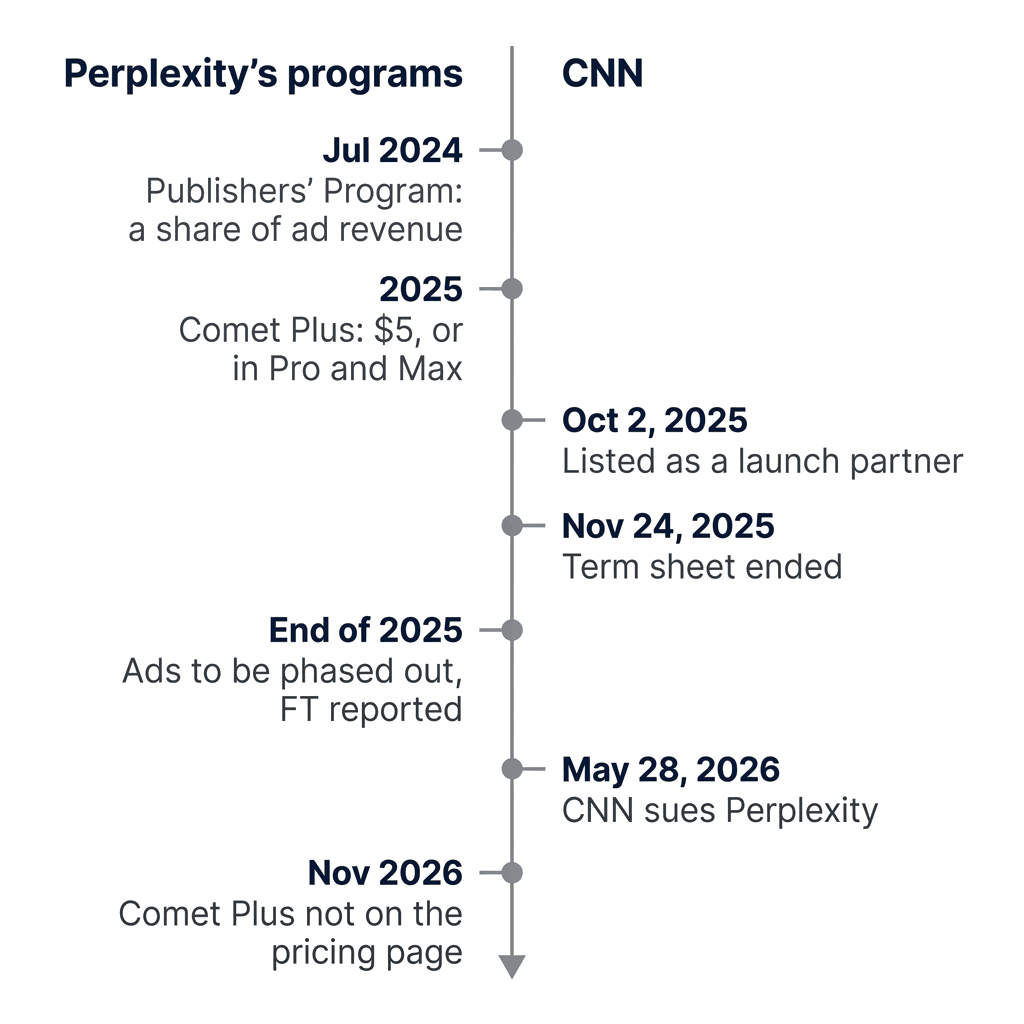
From an ad share in 2024 to a lawsuit in 2026

  • July 2024: an ad-revenue share. The Publishers' Program shared ad revenue "when Perplexity earns revenue from an interaction where a publisher's content is referenced" (Publishers' Program). Of that ad share, Chan told Digiday in August 2025: "we are not disclosing any of those numbers." Asked whether checks had gone out to publishers, she said: "Checks have gone out."
  • From the end of 2025: no ads. The Financial Times reported, as Gigazine relayed, that Perplexity would phase out its ads from the end of 2025 [13].
  • October 2025: CNN, a launch partner. CNN's deal began as a term sheet, "with an agreement to finalize the contract within sixty days" (¶46) [15]. Perplexity's partner page listed CNN as a launch partner from 2025-10-02 until at least 2025-12-04 (Internet Archive, capture of 2025-12-04).
  • November 2025: the term sheet ends. CNN's complaint says the term sheet never became a contract, over issues that include limits on use in answers (see For legal). It says the two agreed to end the term sheet on 2025-11-24 (¶47) [15].
  • May 2026: CNN sues. CNN sued Perplexity on 2026-05-28. Perplexity's response, to TheWrap: "You can’t copyright facts." [19]
  • November 2026: off the pricing page. Perplexity's pricing page and plan guide don't list Comet Plus, and Perplexity hasn't announced its end.
Perplexity's Publishers' Program shared ad revenue from July 2024, Comet Plus ($5, or in Pro and Max) followed in 2025, the FT reported that ads would be phased out from the end of 2025, and in November 2026 Comet Plus is not on the pricing page. CNN was listed as a launch partner from October 2, 2025, the term sheet ended on November 24, 2025, and CNN sued Perplexity on May 28, 2026.
Perplexity's programs and CNN's case, 2024 to today.
Text version

Perplexity's Publishers' Program shared ad revenue from July 2024, Comet Plus ($5, or in Pro and Max) followed in 2025, the FT reported that ads would be phased out from the end of 2025, and in November 2026 Comet Plus is not on the pricing page. CNN was listed as a launch partner from October 2, 2025, the term sheet ended on November 24, 2025, and CNN sued Perplexity on May 28, 2026.

Sources

Sources are checked on the date of publication.

Set your own price for AI access

FORA is an open protocol and free, open-source software. Sell through any FORA marketplace, several of them, or your own: you set terms and a price per resource, and each Exchange signs your offers.

What is FORA? Run your own marketplace Licensing terms All content marketplaces