Web Bot Auth (WBA) is a passwordless, cryptographically proven identity for AI agents.
The key idea: the agent signs every request with a private key that never leaves it, and your site checks the signature against the public key the agent publishes on its own website. A valid signature proves which website's key signed the request, and that the parts it covers weren't changed on the way. A password or API key proves only that the sender has a copy.
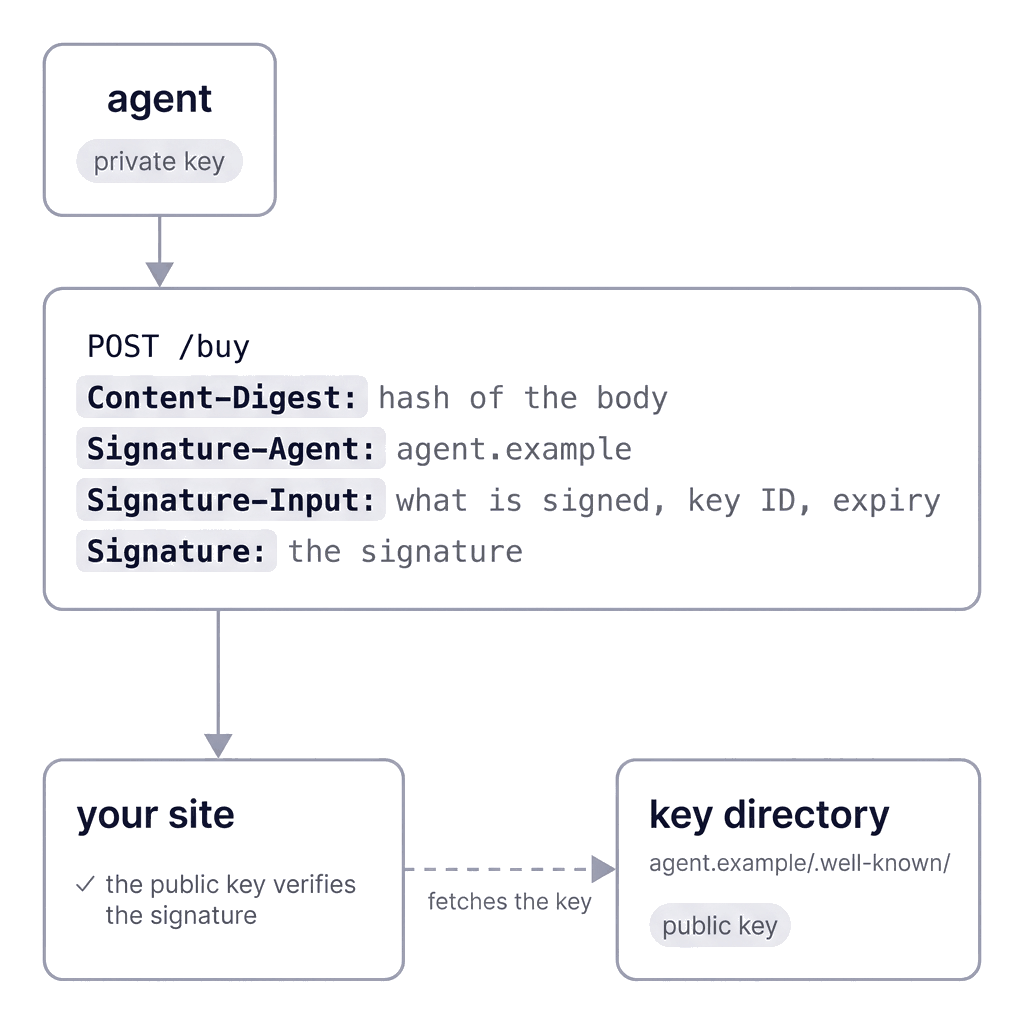
A signed request, read top to bottom. The agent, which keeps its private key, sends a request: POST /buy, with four headers. Content-Digest: a hash of the body. Signature-Agent: agent.example. Signature-Input: what is signed, the key ID and the expiry. Signature: the signature. The request reaches your site, which fetches the public key from the key directory at agent.example/.well-known/ and checks that the public key verifies the signature.
How it works
How Web Bot Auth works
The agent's operator creates a key pair. The private key stays with the agent. The public key goes into the key directory, a small file on the operator's website [1].
The agent signs each request and adds three headers. Signature-Agent names its website. Signature-Input lists what the signature covers, which key made it and when it expires. Signature carries the signature itself [1].
To cover the body, the agent also sends Content-Digest, a hash of the body, and signs it with the rest. A changed body no longer matches its hash, and a changed hash breaks the signature [1, 2].
Your site, or your CDN, fetches the key directory from the website Signature-Agent names, takes the key with the matching ID and checks the signature. If it verifies, a key that website publishes signed the request, and nothing the signature covers was changed on the way [1, 2].
Only requests are signed. Your site answers as usual, and the one reply Web Bot Auth signs is the key directory itself [1]. FORA uses the same keys for two more signatures: the Exchange signs each offer, and the agent signs the offer it accepts, so neither the price nor the acceptance can change on the way [5, 6].
A valid signature proves that much. In the draft's words, it "says nothing about who operates the Agent, whether the Agent is benign, or whether the request is authorized" [1]. Those are yours to decide.
The draft comes from the IETF, the body that writes the internet's protocols. Its working group adopted it as the starting point on September 1, 2026, and it stays a draft until the group finishes it [3].
Why it matters
What it changes for a publisher
You can set terms per agent. Sell to it, slow it down, serve it differently or refuse it, by its website's address [1].
You know who you're dealing with. Anyone can type a user agent, and a cloud IP address is shared by everyone who rents from that cloud [1]. A signature names the website behind the agent.
A leaked signature expires. A signature works only at the site it was made for, and only until it expires: at most a day by the draft's advice, and often a minute [1, 12]. Cover the path and a hash of the body, and it fits one request. A leaked password or API key works wherever it's accepted until someone revokes it.
A page you sell stays sold to one buyer. On FORA, the link to a sold page works only for the agent that holds the buyer's key, so a copied link fetches nothing [7].
No passwords or API keys to issue. An agent can open an account on its first signed request, with no sign-up form. You keep only public keys, and a public key can't sign anything [1, 2]. The draft calls a secret shared with every site "impractical to scale" and "insecure, as key rotation is challenging" [1].
It doesn't cover the crawlers in your licensing talks. GPTBot, ClaudeBot, PerplexityBot and Googlebot don't sign [13, 14, 15, 16]. Hidden crawlers stay hidden too. For those, robots.txt, IP lists and contracts remain the tools. How to control which bots get in →
Two ways to open an account.Text version
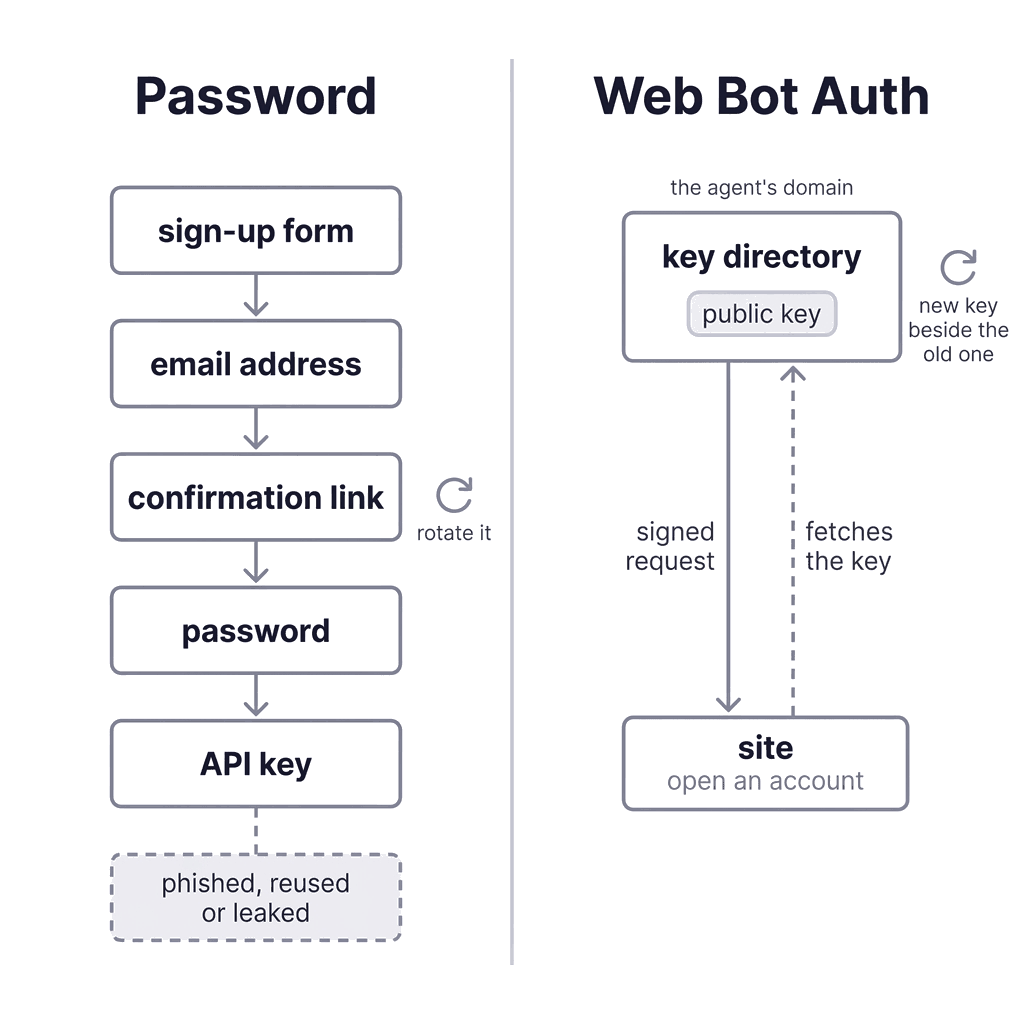
Two ways for an agent to open an account at a site. With a password: a sign-up form, an email address, a confirmation link, a password and an API key, one after another. Each can be phished, reused or leaked, and someone has to rotate it. With Web Bot Auth: a key directory on the agent's domain holds its public key. A signed request goes to the site, which fetches the key from the directory and can open an account. To rotate, the agent publishes a new key beside the old one.
Who signs
Which agents sign
Little agent traffic is signed yet, and most of what is comes from ChatGPT's agent. These agents sign, those still testing it included:
Who
What signs
Status
How you can tell
OpenAI
ChatGPT Work's Cloud browser, as https://chatgpt.com
Live
OpenAI's allowlisting guide; its key directory answers [17]
Google
Some Google-Agent requests, as https://agent.bot.goog
Experimental
"We don't sign every request of a particular agent" [13]
Cloudflare
Its own fetchers, among them Browser Run, its crawler and AI Search
"Every ExaSearchBot request is cryptographically signed"; ExaUser is listed on Radar [19, 20]
BrowserbaseHosted browsers, for accounts Browserbase enables
Status
Closed beta
How you can tell
"Contact Browserbase to enable Web Bot Auth for your account" [21]
ShopifyCloudsurf, its agent browser for Sidekick
Status
Live
How you can tell
Listed on Radar, with a key directory that answers [19]
AmazonBedrock AgentCore Browser, when the customer turns it on
Status
Preview
How you can tell
"The feature is disabled by default and must be explicitly enabled" [22]
The rest don't sign, the large training and search crawlers among them. OpenAI's GPTBot, OAI-SearchBot and ChatGPT-User, Googlebot, Anthropic's ClaudeBot, Claude-User, Claude-SearchBot and its hosted browser Claude-Agent, and Perplexity's PerplexityBot and Perplexity-User identify themselves by user agent, reverse DNS and published IP lists [13, 14, 15, 16, 19, 23, 24].
2.3%
Of the agent sessions Arkose Labs judged legitimate carried a verified signature, on login, registration and checkout pages, Q3 2026. Arkose's own data [26]
78.4%
Of ChatGPT agent's sessions were signed in the same report, "the only agent that signed at scale" [26]
12 of 41
Bots in Cloudflare Radar's AI crawler category can sign. GPTBot, ClaudeBot, Amazonbot and Meta's crawlers aren't among them [19]
Keys
Key directories, rotation and revocation
The key directory itself is signed, once with each key it lists. Cloudflare's reason: it "ensures no one else can mirror your directory and attempt to register on your behalf". Cloudflare requires it before it registers a directory, and so does FORA [5, 12].
Verifiers differ on when they read the directory. Cloudflare checks signatures only against keys registered with it in advance: the operator submits its directory through Cloudflare's bot submission form, and a signature from a key Cloudflare doesn't know gets a 401 [12]. Holding the keys beforehand means nothing is fetched while a request waits. The draft also lets a verifier fetch the directory when a signature arrives, and FORA does: an agent registers with no one, and FORA caches the keys it fetches [1, 5].
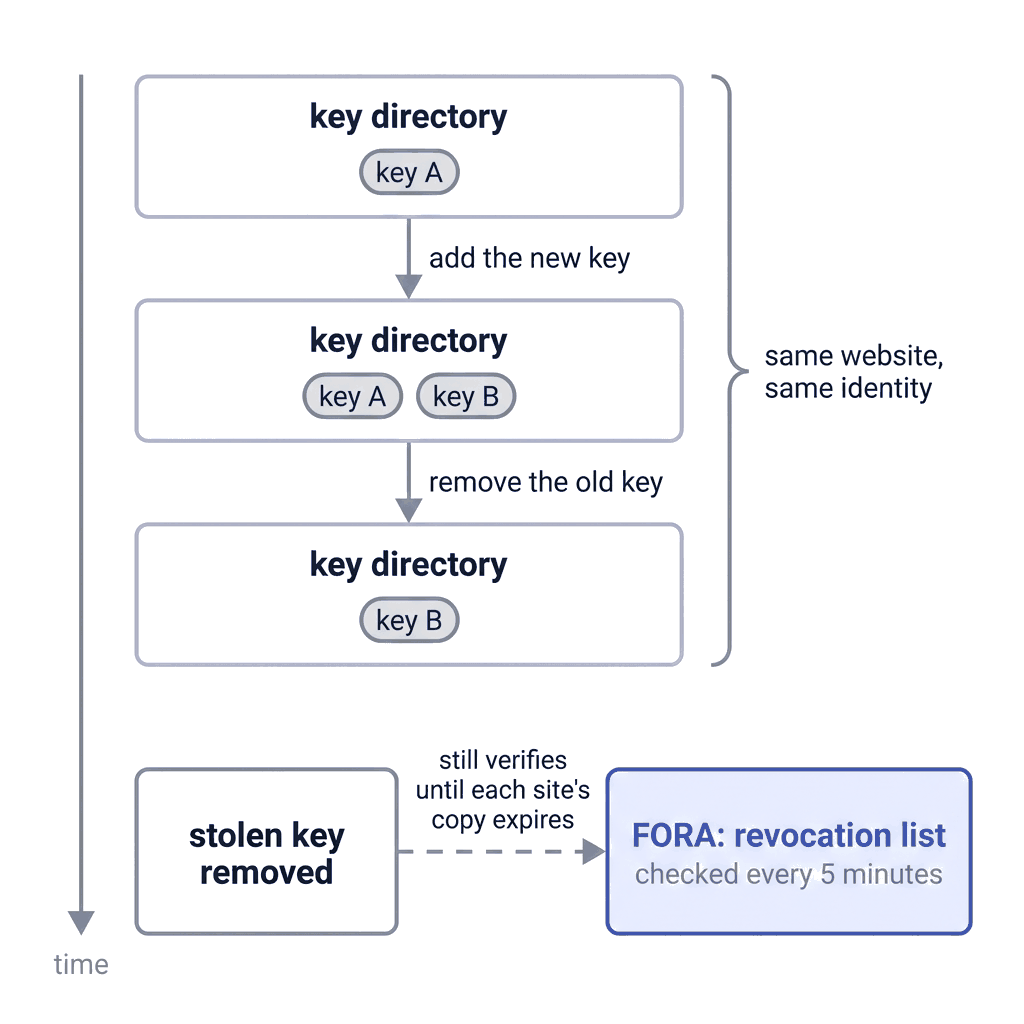
Rotation is built in. The agent adds a new key next to the old one, starts signing with it, and removes the old key once it expires. Sites that knew the agent before still recognize it, with no third party involved [1].
Revocation is not: "This document defines no revocation" [1]. If a key is stolen, whoever holds it can pass as the agent and buy or read whatever you allow it. The agent removes the key from its directory, but your CDN keeps trusting its cached copy until that expires, a day in the draft's example, and the standard has no faster way to tell you [1]. FORA adds one: a directory can name a revocation list, and FORA's checks read it every five minutes [5].
Rotation and removal.Text version
The life of a key in a key directory. Over time the directory holds key A, then key A and key B ('add the new key'), then key B ('remove the old key'): same website, same identity. Below the three directories, a stolen key is removed but still verifies until each site's copy of the directory expires. FORA adds a revocation list, checked every five minutes.
What to ask
What to ask your CDN and your team
Your site doesn't have to sign anything. It can check signatures itself or leave that to the CDN or bot vendor in front of it [1].
Ask your CDN or bot vendor
Do you verify Web Bot Auth signatures, and whose? Cloudflare verifies bots that registered their key directory with it [12]. AWS WAF labels each signed request verified, invalid, expired or unknown [27]. Akamai, HUMAN and Vercel verify ChatGPT's cloud browser, by OpenAI's guide [28], and DataDome verifies bots that apply through its form [29].
Can our rules treat signed, unsigned and failed requests differently? AWS WAF lets a custom rule act on its label [27]. Shopify, for one, gives bots that don't sign "the strictest limits" [30].
Will our bot rules let FORA buyers through? Cloudflare's built-in check reads the format used before the working group adopted the draft, and rejects the adopted format FORA uses. On Cloudflare, FORA's own edge function does the check [12].
Ask your engineers
Which of our pages are for sale? Only those need a signature check. Open pages stay open.
Where would FORA's edge function run? It's a drop-in on Cloudflare Workers, Fastly Compute and Lambda@Edge [7].
Access
Choosing which agents you sell to
Your readers and search crawlers reach your open pages as before. What follows is only for the pages you sell access to.
Once a domain is verified, you can decide by it. The draft says sites "can log, rate limit, allowlist, or block the URL the way they do IP addresses and User-Agent today" [1]. So keep a list of the domains you want to sell to. A request whose signature fails gets nothing on those pages, and so does a domain your list doesn't name.
You can keep the list yourself or start from a vendor's. In Cloudflare's dashboard you set an action for Search, Agent and Training traffic, and for "the top Personal Agents" [32]. The bots come from Cloudflare's own reviewed registry [25]. A registry draft from Cloudflare and Amazon also defines a shared list, plain text with one URL per line, that a site "MAY manually add" to its own [33].
The approved accounts.Text version
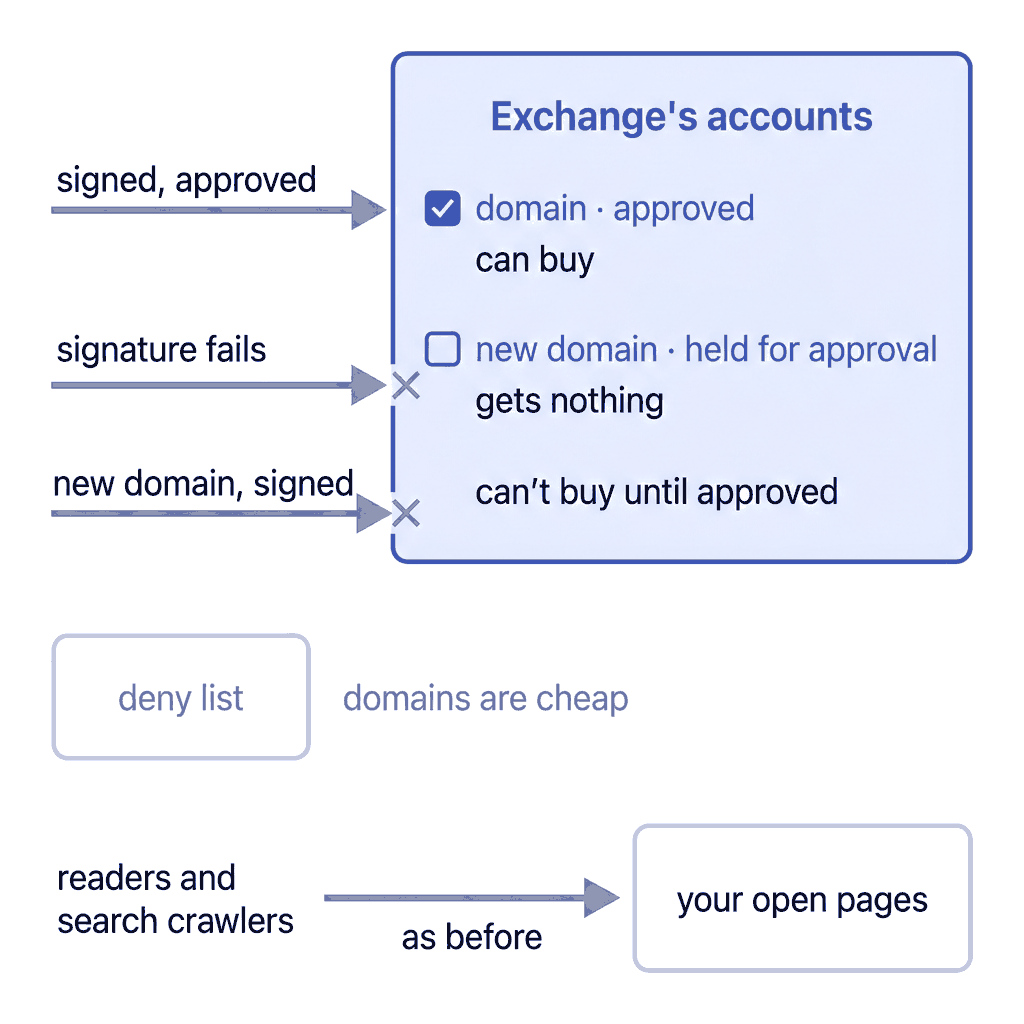
An Exchange's accounts, each with a checkbox: one domain approved, one new domain held for approval. A signed request from the approved domain can buy. A request whose signature fails gets nothing. A signed request from the new domain can't buy until it's approved. Beside them, a deny list: domains are cheap. Readers and search crawlers reach your open pages as before.
On FORA, the list is an Exchange's accounts, and each account belongs to a domain. The Exchange's operator can open new accounts at once or hold them for approval, and can switch any account off [5, 9]. The approval can ask for what a domain doesn't prove, such as a legal name and a VAT number [9, 10]. If you run your own Exchange, as Gutefrage does, the approval is yours.
A deny list is weaker: it stops one domain, and domains are cheap. The draft agrees:
Nothing stops an Agent from abandoning a URL and standing up another one, and the protocol does not try to prevent this. It targets honest clients that want to be recognised across requests.
A Web Bot Auth signature carries no permissions [1]. What an agent may do comes from your rules for its domain, an OAuth token it sends with the request, or a license; on FORA, the license, whose terms "the parties agree to when the agent accepts the offer" [6].
The working group has chosen its technical starting point. In May 2026 it decided to work on anonymous approaches in parallel with identity [34]. At IETF 126 in July, the room backed the signing draft as the starting direction, 22 to 6 [35]. The group adopted it on September 1, 2026 [3].
The supporters are the companies that handle bot traffic at scale. Engineers from Google, Anthropic, Shopify, Amazon, Stytch and the BBC backed adoption on the list, and the draft's authors work at Cloudflare and Google [1, 3]. Their case is cheap, certain checks and less blocking of innocent traffic by IP. Mark Nottingham, who wrote a use-cases draft for the group, says IP-based arrangements are opaque, and an authentication infrastructure can "put some daylight on those arrangements" [36].
The critics are civil-society groups and the research and scraping side. They fear sites will pick whom to let in by name, whatever a bot does. The EFF wrote in June 2026 [37]:
If sites restrict crawling to a preapproved list of cryptographically authenticated bots, they could require licensing payments from those wishing to crawl their sites. This would close off the open web to researchers, archivists, and startups without the ability to pay for automated access.
Writing on the working group's list, Mirja Kühlewind warned that once enough sites block everything unsigned, "at some point there might not be a choice anymore" [38]. A domain key is also a stable identifier: the draft says it lets sites correlate requests "including across origins" [1]. Cloudflare, whose engineer is the draft's first author, wrote that "Infrastructure for proving properties can become infrastructure for requiring properties" [39].
Signing can't name a bot that won't sign, so publishers who want hidden crawlers named are turning to law. New York's legislature passed a Stealth Crawler Prohibition Act in June 2026 with the News/Media Alliance's support [40, 41]. In August, the EFF and 18 groups asked the governor to veto it [42].
On FORA, an agent signs when it uses FORA to find or buy licensed content [5]. Reading and search stay open, and nobody signs to read a public page. A buying agent is recognizable at every Exchange it uses [1]. Requiring signatures only on the pages you sell keeps your open pages out of this fight.
FORA
How FORA uses Web Bot Auth
Every party in FORA signs its requests with a key its own domain publishes [5]. For an agent that buys content:
The identity is the domain. An agent is the host that serves its key directory: "If you control the domain, you control the key." A subdomain is a different party [5].
Registration carries no password or API key, because the signature is the credential. The Exchange reads who is registering from the verified signature alone [9].
Each signature covers more than the minimum: the method, the full address, a digest of the body and a one-time random value. It lives a few minutes. A request that fails the check is rejected, with "No fallback, no degraded mode" [5].
The account belongs to the domain, and a key rotation keeps it [5].
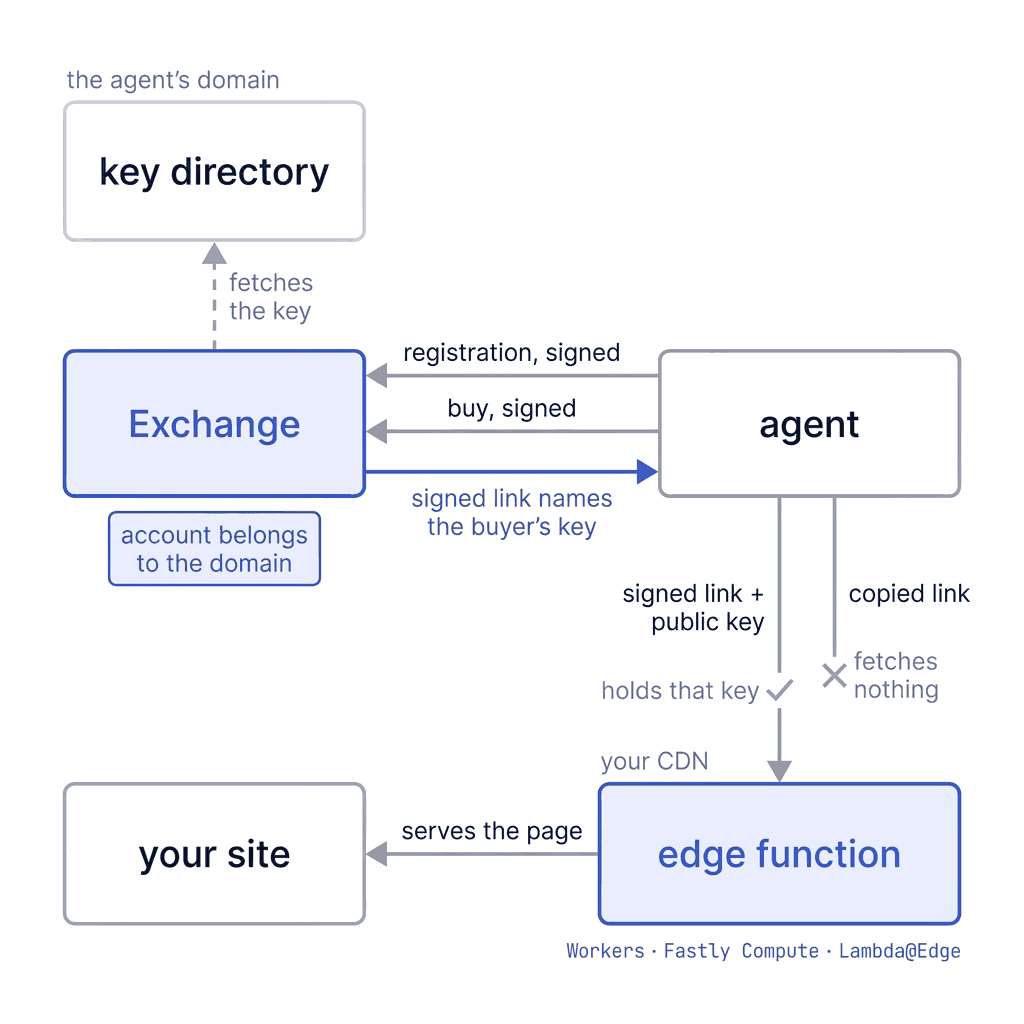
The signed link names the buyer's key, and FORA's edge function on your CDN checks it [7].
How a FORA agent registers and buys.Text version
How a FORA agent registers and buys, across the key directory on the agent's domain, the agent, the Exchange, FORA's edge function on your CDN (Workers, Fastly Compute or Lambda@Edge) and your site. The agent sends a signed registration to the Exchange, which fetches the key from the key directory; the account belongs to the domain. The agent sends a signed purchase, and the Exchange returns a signed link that names the buyer's key. The agent sends the signed link and its public key to the edge function, which checks that it holds that key, and your site serves the page. A copied link fetches nothing.
An agent without a domain of its own can use FORA's Identity Service. It gives each agent its own subdomain, so each is a separate party at every Exchange, publishes the agent's key directory, keeps the private key and signs for the agent [8].
The detail, for engineers
Questions
Do I need Cloudflare, or any one vendor, to check signatures?
No. The key directory sits on the agent's domain, and any site or vendor can check it by the draft's rules [1]. Each verifier decides which agents it knows. Cloudflare's checks the directories registered with it [12].
Why not use OAuth instead?
Use OAuth for what the agent may do. Web Bot Auth says which website is asking and carries no permissions; an OAuth token carries them [1, 43]. How the two fit together →
Does requiring signatures affect search?
Googlebot doesn't sign, and Google tells sites to keep relying on IP addresses, reverse DNS and user agents alongside Web Bot Auth [13, 19]. FORA's edge never refuses Googlebot, Bingbot or Applebot [11].
Will a signature rule refuse agents I want?
It can. Google signs only some Google-Agent requests and tells sites to fall back to the older checks [13]. On Arkose's network, most legitimate agent sessions carried no verified signature [26].
Does Web Bot Auth track my readers?
No. It identifies agents, and a person reading your site signs nothing. One identifier links an agent's requests across sites, so the draft calls it unsuited to an identifier tied to one person [1].
Does an agent have to register with each verifier?
Not by the draft, which asks for no prior relationship [1]. Cloudflare counts signatures from bots that registered their key directory through its bot submission form [12]. DataDome asks operators to apply through a form [29]. AWS WAF checks the signature against the agent's key directory and labels the result [27]. A FORA Exchange checks a signature from any key directory that meets FORA's rules, and an account takes one signed request [5, 9].