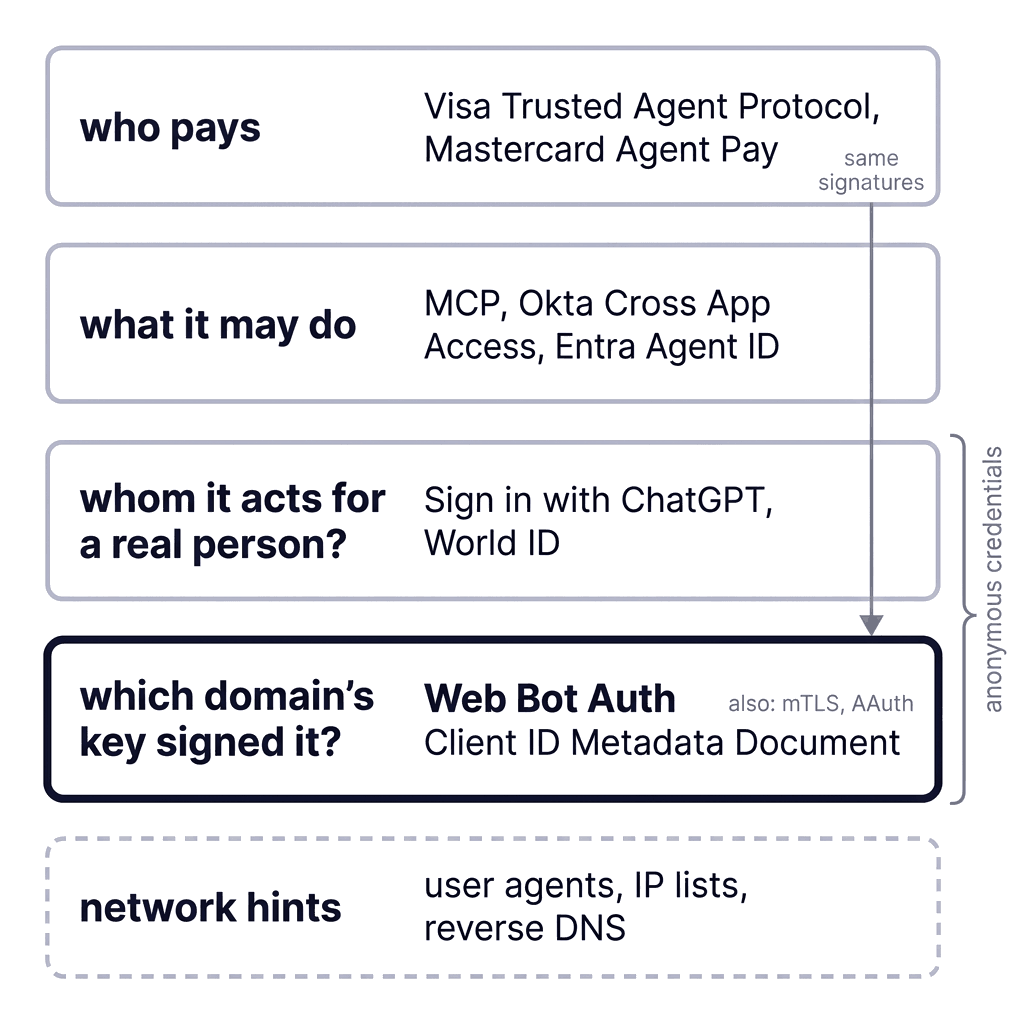
When an AI agent asks for your content, four questions matter: who it is, whom it acts for, what it may do, and who pays. No one standard answers all four. This page shows which one answers which, and where you'll meet each.
Updated
| What answers it | Where you meet it | |
|---|---|---|
| Who is it? | Web Bot Auth: a signature checked against a key on the agent's own website. For the big crawlers, IP lists and reverse DNS [1, 2] | On each request from an agent that signs. Your CDN or bot vendor can check it [3] |
| Whom does it act for? | A sign-in: Sign in with ChatGPT, World ID, or your own login through OAuth [5, 6, 7] | When a reader's assistant opens the reader's account with you [5] |
| What may it do? | An OAuth token and its scopes; on FORA, the license [7, 8, 11] | When you offer an API or an MCP server, or sell licenses |
| Who pays? | Card networks: Visa's Trusted Agent Protocol and Mastercard Agent Pay [15, 16] | While an agent browses and when it pays; you or your CDN can check [15, 16] |

Five layers of agent identity, bottom to top. Network hints: user agents, IP lists and reverse DNS, drawn dashed. Which domain's key signed it: Web Bot Auth, drawn heaviest, with Client ID Metadata Document, and also mTLS and AAuth. Whom it acts for, and whether a real person stands behind it: Sign in with ChatGPT, World ID. What it may do: MCP, Okta Cross App Access, Entra Agent ID. Who pays: Visa Trusted Agent Protocol and Mastercard Agent Pay, on the same signatures as Web Bot Auth. Anonymous credentials sit beside the identity and real-person layers.
The rest of this page you can leave to your engineers for now.
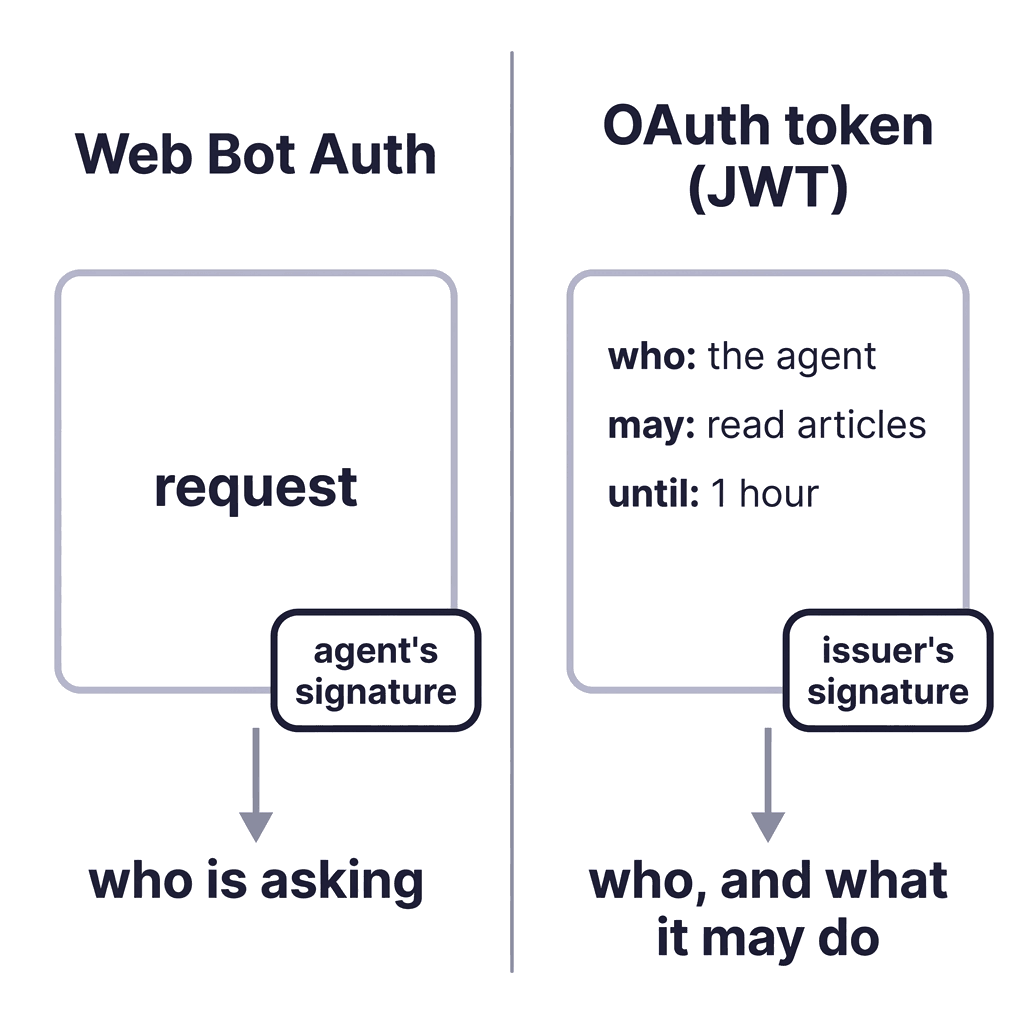
The agent signs each Web Bot Auth request itself, and the signature names the website whose key made it [1]. An OAuth access token comes from a sign-in server and lists the scopes, what the agent may do. In its JWT form it also names the client, and the server signs it [8, 17].
A plain token is a bearer token: whoever holds it can use it [18]. OAuth's security best practice asks servers to bind tokens to the client's key, with mutual TLS or DPoP [19].

Two things side by side. Web Bot Auth: a request with the agent's own signature on it, which tells you who is asking. An OAuth token, a JWT: a card that says who the agent is, what it may do (read articles) and until when (one hour), signed by the issuer, which tells you who is asking and what it may do.
| API key | OAuth token | Web Bot Auth signature | |
|---|---|---|---|
| What it tells you | Who it is and what it may do | What it may do, for whom, and often who it is [8, 17] | Which website it signs for [1] |
| Who issues it | You, at sign-up | A sign-in server, which can be yours [7] | The agent, itself [1] |
| If it's stolen | The thief is the agent [18] | The same, unless the token is bound to a key [20] | The thief is the agent until the key is removed and each site's copy expires [1] |
| Before the first request | A sign-up | Registering the app, or an app ID that is a web address, and often a person's approval [7, 21] | Nothing by the standard. Some verifiers, Cloudflare among them, ask an agent to register its keys first [1, 3] |
| Rotation | Again at every site | At each sign-in server, or once if the app publishes its keys [21, 22] | Once, in the agent's own key directory [1] |
An agent can carry both: a signature for who it is and a token for what it may do. FORA's own signature covers the request's token header too [12]. Permissions can also shrink as they pass along: whoever holds a Biscuit token can add restrictions without asking the issuer, and the token "will never gain more rights" [23].
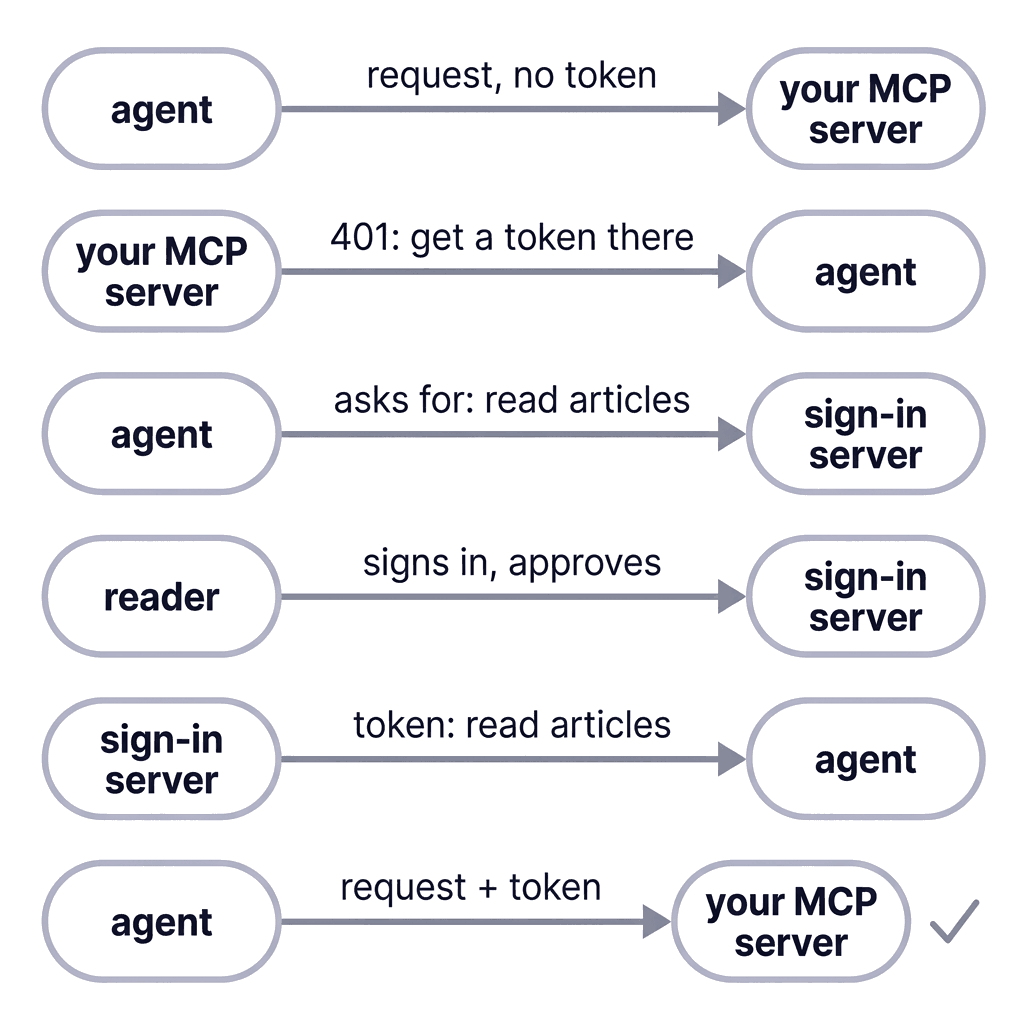
If you want subscribers' AI assistants to read what they've paid for, OAuth is how. A reader signs in through your login and approves what the assistant may do, and your server lets the assistant in for that reader only. MCP, the protocol AI assistants use to reach tools and data, uses OAuth when a server requires permission [7]:

How an agent gets permission through MCP, across the reader, the agent, your MCP server and the sign-in server. The agent calls your MCP server with no token and gets a 401 that says where to get one. The agent asks the sign-in server for permission to read articles; the reader signs in and approves. The sign-in server gives the agent a token for reading articles, and the agent calls your MCP server again with the token, which your server accepts.
MCP prefers that the app's ID be a web address pointing to a document the app publishes about itself, much like a Web Bot Auth key directory [21]. An agent that buys for its own company, with no reader involved, needs none of this flow: Web Bot Auth and a license can be enough.
Visa and Mastercard both use the same kind of signature as Web Bot Auth. Visa's Trusted Agent Protocol builds on the same internet standard and is aligned with Web Bot Auth. An agent signs both while it browses and when it pays, and a valid signature "proves the Agent's participation in the Payment Scheme specific program" [15]. Mastercard Agent Pay certifies agents and lists them in a registry that "Your systems can query … either directly or through your edge provider" [16].
The difference is who holds the public key. In Web Bot Auth it's the agent's own website. Here it's the card network's registry, so a valid signature tells you the agent is enrolled in a card program [1, 15, 16]. Mastercard warns that agents people run on their own won't carry these signatures:
Consumer-owned agents will not have scheme credentials — and that is expected.
You'd meet these if you let readers' assistants sign in for them. Sign in with ChatGPT links a customer's ChatGPT identity to their account with you: your site verifies the identity token, "creates or links the appropriate merchant account, and starts its own session". It's open to select commercial partners, and "a ChatGPT identity is not purchase approval" [5].
World ID tells you a person stands behind an agent, and how well World checked. Its iris-scanning Orb "provides high assurance of unique humanness"; a camera check gives a medium-assurance signal [24]. Your site gets a signed result and an account ID that differs from one group of sites to the next [6]. World says what it leaves out: "This does not prove the agent itself is human or grant it access to another service" [25].
Web Bot Auth can name a platform or each agent on it. A platform can sign for all of its users under one name, or a registry can give each agent its own subdomain and key directory, so each agent is recognizable on its own [26]. Naming each person who uses a platform is where Cloudflare draws the line: extending Web Bot Auth "to identifying individual users of the platforms" "would create an unacceptable privacy risk for these users". With anonymous credentials, the AI platform vouches for its user, and a site can rate-limit that user without learning who it is [27]. Apple's Private Access Tokens do the same for devices: they "prove when HTTP requests are coming from legitimate devices without disclosing someone's identity" [28].
The Web Bot Auth working group decided in May 2026 to work on anonymous approaches alongside identity [29].
| What it proves | Where you'd meet it | Matters now? | |
|---|---|---|---|
| User agents and IP lists | Little: anyone can type a user agent, and cloud IP addresses belong to the platform [1] | On every request | Yes, for crawlers that don't sign. Google still tells sites to use them [2] |
| Okta Cross App Access, Microsoft Entra Agent ID | An agent acting for an employee, managed in the company's directory [9, 10] | A corporate customer's agents using an API you run for it | If you sell data or APIs to companies |
| Client certificates (mTLS) | The client holds a certificate [30] | Between known partners. A user without one gets "an inscrutable and unskippable error" [30] | No |
| Decentralized identifiers (DIDs), did:web | The controller of an identifier controls it "without requiring permission from any other party" [31]. did:web keeps the keys on a website, as Web Bot Auth does [32] | Identity and credential programs | Not for bot traffic |
| Verifiable credentials | Claims an issuer signs about someone, "such as a driver's license or an education certificate" [33] | Credential programs; a registry could vouch for an agent's operator this way | Not for bot traffic |
| AAuth | Identity and permission together, on the same kind of signature [34] | Individual IETF drafts, not adopted by a working group [34] | Worth watching |
As two things. Its signature tells you it's ChatGPT's agent [13]. Whether it may read your subscriber's articles takes the subscriber's own sign-in, through your login or Sign in with ChatGPT [5, 7].
No. OAuth carries permission, and Web Bot Auth carries identity. The Web Bot Auth registry draft even accepts an app's OAuth self-description as a valid "Signature Agent Card" [4].
Sources are checked on the date of publication.
See what an agent would be offered for one of your pages through a FORA marketplace, which any company can run, or read how FORA agents sign.